Triumph TR4 History
From Michelotti's Zest and Zoom prototypes and a company rescued by Leyland to the last TR4A of July 1967: how the TR4 was made, sold mostly in North America, raced and rallied, and replaced by a six.
About the pictureA TR4 in a museum in 2021, standing in for a period photograph
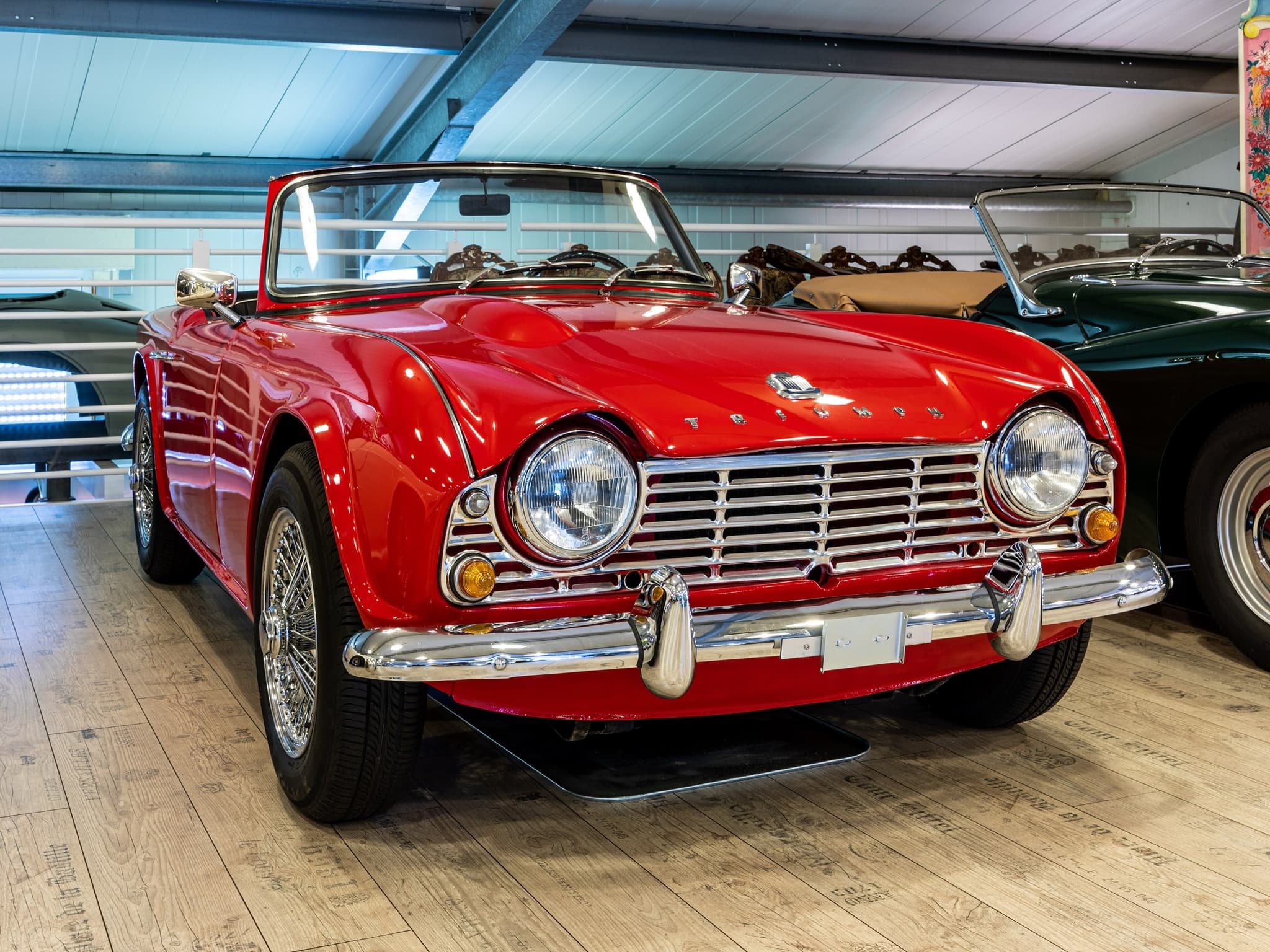
Standard-Triumph's board had a name ready for its next sports car in the summer of 1960, and it was not TR4.
It was resolved that Zest be called the Triumph Dolomite and that Zoom be called the Triumph Vitesse.
Neither name went on a TR. Within months the company had run out of money and passed to Leyland, and the car that reached the showrooms in the autumn of 1961, with Zest's nose and Zoom's rear wings (fenders) and tail on a widened TR3A frame, was the TR4. This page follows it from Giovanni Michelotti's first work for Standard-Triumph to the last TR4A, built in July 1967.source 1source 2source 3source 4
Standard-Triumph and Michelotti, 1957–60
Standard-Triumph began planning a successor to the TR3 around the middle of 1957, Ate Up With Motor writes, with a launch in 1959 in mind; the German TR Register says the works were already using the name TR4 in 1956. The company was run by Alick Dick, its managing director since early 1954, with Harry Webster as its engineering chief. Walter Belgrove, who had styled the TR2 in-house, had resigned late in 1955, so the new car's shape would come from outside.
It came from Turin, though who first brought Michelotti to Standard-Triumph, in 1957, depends on the source. The German TR Register and Graham Robson say that a customer, Raymond Flower, introduced him, and the German guide adds that a TR3 chassis was sent to Italy and that the first project took three months and cost £3,000. Ate Up With Motor speaks only of "an outside businessman"; G. William Krause has Dick meeting Michelotti by chance at a motor show; and Webster's obituary in the Daily Telegraph says that Webster discovered him. No source read reconciles them.
His first sports car for the company was a show car, the TR3-based "Dream Car", built by Vignale and shown at Geneva in March 1957, which Ate Up With Motor calls "more an audition than a serious production prospect". For the Herald saloon (sedan) of 1959, by Webster's account as Ate Up With Motor gives it, Michelotti produced the concept and a full set of scale drawings in under 24 hours. Webster gave the projects four-letter code names beginning with Z, to confuse rivals: the Herald was Zobo, and the TR3's successors were Zest and Zoom.source 2source 5source 6source 3source 7
Zest, Zoom and the TR3 Beta, 1958–60
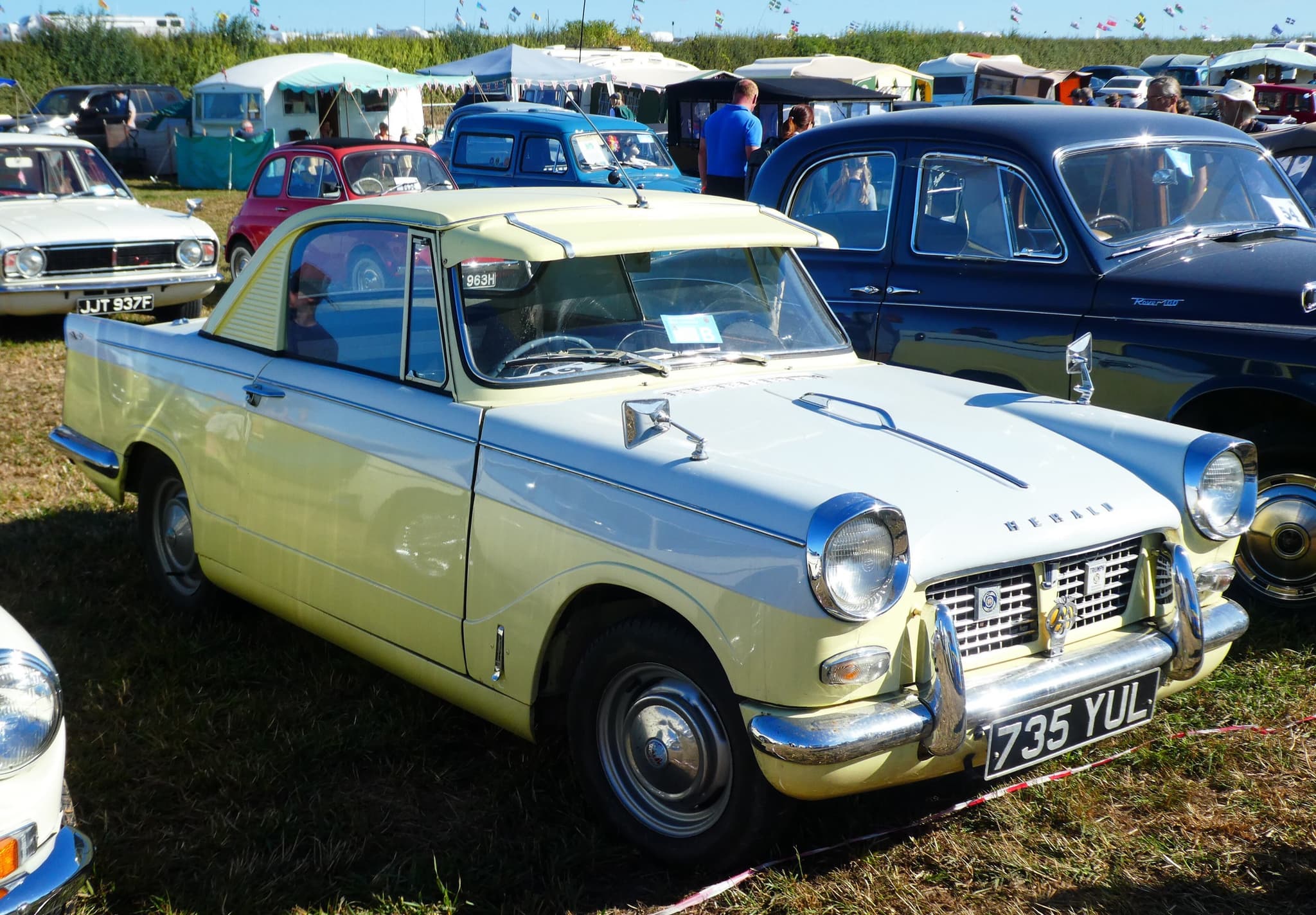
Zest, commissioned later in 1957, was delivered early in 1958 on the latest TR3A chassis: a squarer body with fin-like rear wings, a scoop on the bonnet (hood), headlamps partly hooded in the grille and a steel hardtop based on the roof of the Herald coupé. Krause calls it "the ultra-conservative brother of the Dream Car". Its nose is close to the production TR4's.
Zoom followed: two cars, built by Vignale in Turin in 1959 to take the twin-cam 20X engine that Standard-Triumph was developing, on a frame with a longer wheelbase and wider tracks. They had conventional doors with wind-up windows, a fixed, curved windscreen (windshield) and a proper hood (soft top), and one of them a two-piece hardtop whose centre panel lifted out: the TR4's hardtop in outline. Krause writes that management picked Zoom almost at once, but a detuned twin-cam proved too costly for a road car. Its shape went racing instead. The TRS cars that Triumph ran at Le Mans in 1960 and 1961 wore glass-fibre bodies on Zoom's lines, and in 1961 Car and Driver noted that from the windscreen pillars back the TR4's body was the same as the twin-cam Le Mans car's. According to Revington TR, the hardtop Zoom survives, and was the buck for the TRS moulds.
Money settled the rest. In the late summer of 1960, Ate Up With Motor writes, the longer wheelbase was given up, since the twin-cam would fit the TR3A frame after all, and the wider tracks kept. Zest was too small and Zoom too big, so Michelotti drew "a Goldilocks version" of the two, with an asymmetric bulge on the bonnet to clear the carburettors in place of Zest's scoops. On 19 September 1960 the board dropped Zebu, a saloon project, and with it, as AROnline quotes the minutes, resolved to keep a live axle for Zest; Zest and Zoom together were costed at £676,000.source 2source 3source 8source 9source 1
Leyland and the money, 1960–61
The money ran out in 1960. After BMC bought the body maker Fisher & Ludlow, Dick bought suppliers of his own to protect Standard's supply, Mulliners of Birmingham and Alford and Alder among them; he left tractor-making, which passed to Massey-Harris-Ferguson, in 1959, and spent the proceeds on the Hall Engineering body plant at Speke, near Liverpool, and on land for a second car plant. AROnline records that the Speke expansion was announced on 9 February 1960, at £11 million of an £18 million programme. Then exports slipped and a credit squeeze took hold: by the summer of 1960, Ate Up With Motor writes, volume had fallen by more than 40% and the company was losing £600,000 a month.
Leyland Motors moved in November 1960. Its chairman, Sir Henry Spurrier, telephoned Dick on 14 November and made his offer on 16 November, AROnline records. The deal was announced in December; AROnline has the purchase completed by the end of January 1961, and Ate Up With Motor in the spring.
The new car did not come cheap. On 8 March 1961 the board heard that the Zest programme had risen by £259,000 to £933,000, and Ate Up With Motor puts the tooling at almost £1 million. To save money Leyland considered going back to sidescreens in place of the wind-up windows, and decided that would be a false economy. In 1961 the new owners also closed the competitions department.source 2source 1source 10source 11
Building and launching the TR4, 1961
Building began with CT1 on 18 July 1961. The bodies were pressed and assembled at Speke and taken by road to Canley, Coventry, for final assembly; Ate Up With Motor dates pilot production to August.
A month after CT1, on 17 August 1961, Spurrier and Stanley Markland dismissed most of the Standard-Triumph board in Harry Webster's office. The news was given out on 21 August, Dick was asked to resign, and Markland took charge as managing director. The car was announced on 1 September 1961, the day after a meeting Markland held on 31 August, AROnline records, and Motor Sport described it in its September issue. In October it was on the stands at the London Motor Show at Earls Court, where Pathé's commentary called it "that big dollar earner", and at the Paris salon.
The first cars were for America. Motor Sport reported that the whole of the first production was reserved for North America, and Gordon Wilkins wrote in Motor Trend:
It has been designed primarily for the North American market, and the plan is to export more than 90 per cent of the output.
Standard-Triumph told its American owners' club in September 1961 that the TR4 was "now rolling off the production lines" and would reach dealers in the late autumn, with features "requested by you and the rest of the 60,000 TR-3 drivers in the United States". Its price was a little higher than the TR3A's, and the TR4 page gives it.
The first reports were warm: Car and Driver put the TR4's arrival on a level with the E-Type Jaguar's, and Wilkins preferred its ride to the TR3's. Road tests gathers what the period testers wrote.source 4source 12source 2source 13source 14source 1source 15source 16source 17source 18source 9
The TR3B interlude, 1962
Not everyone in America wanted the new car at once. Standard-Triumph's distributors there feared, Ate Up With Motor writes, that buyers would see it as Triumph going soft, and the company agreed to keep the old car going. For 1962 it built the TR3B, for export to North America only: the TR3A's body with the TR4's running gear, its all-synchromesh gearbox (transmission) and, on all but the first few hundred cars, its bigger engine. It was built in Birmingham, and 3,331 were made before it ended late in 1962.
So the TR4 did not replace the TR3 everywhere at once. Car and Driver's first report, and the factory's own message to American owners, said it would sit beside the TR3 rather than replace it, while Motor Sport told its British readers that month that it would replace the TR3. In America the TR3 carried on for 1962 as the TR3B; elsewhere the TR4 took the TR3A's place. The fear proved groundless: Ate Up With Motor writes that "concerns that North American buyers would shy away from the new body proved unfounded".source 2source 4source 9source 18source 15
The TR4 years, 1961–65
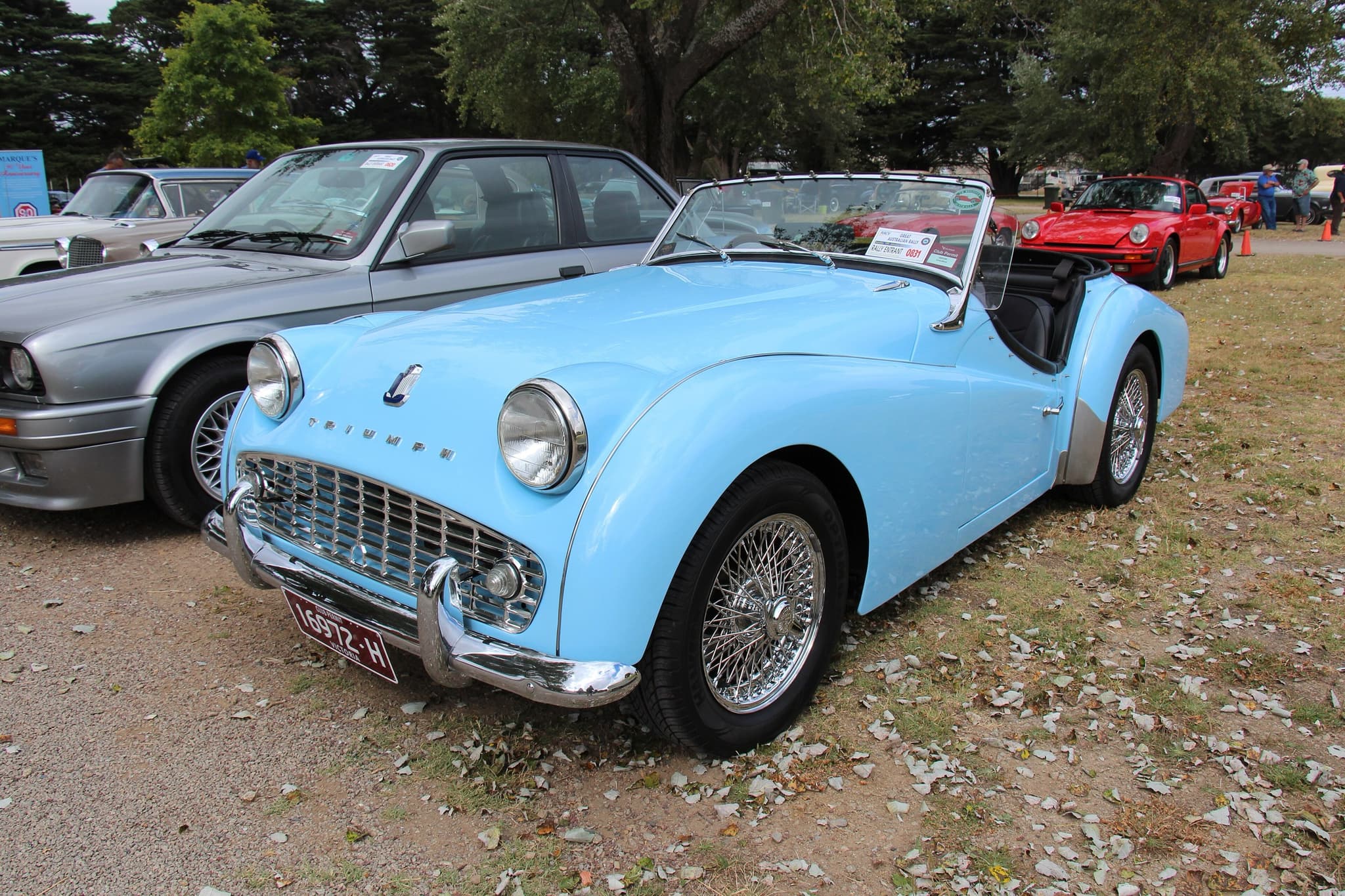
The TR4 changed in detail as it was built. In 1962 the front suspension and the front brake calipers were revised, the bulge on the bonnet was lengthened and the instruments lost their domed glass; better seats came over the winter of 1962–63, the steering rack was set level, and Zenith-Stromberg carburettors replaced the SUs during 1963, for commercial rather than performance reasons. Walnut became common on later TR4s' dashboards. The TR4 page dates each change by commission number. Even at its peak, Ate Up With Motor judges, the TR4 was never quite as popular as the TR3A.
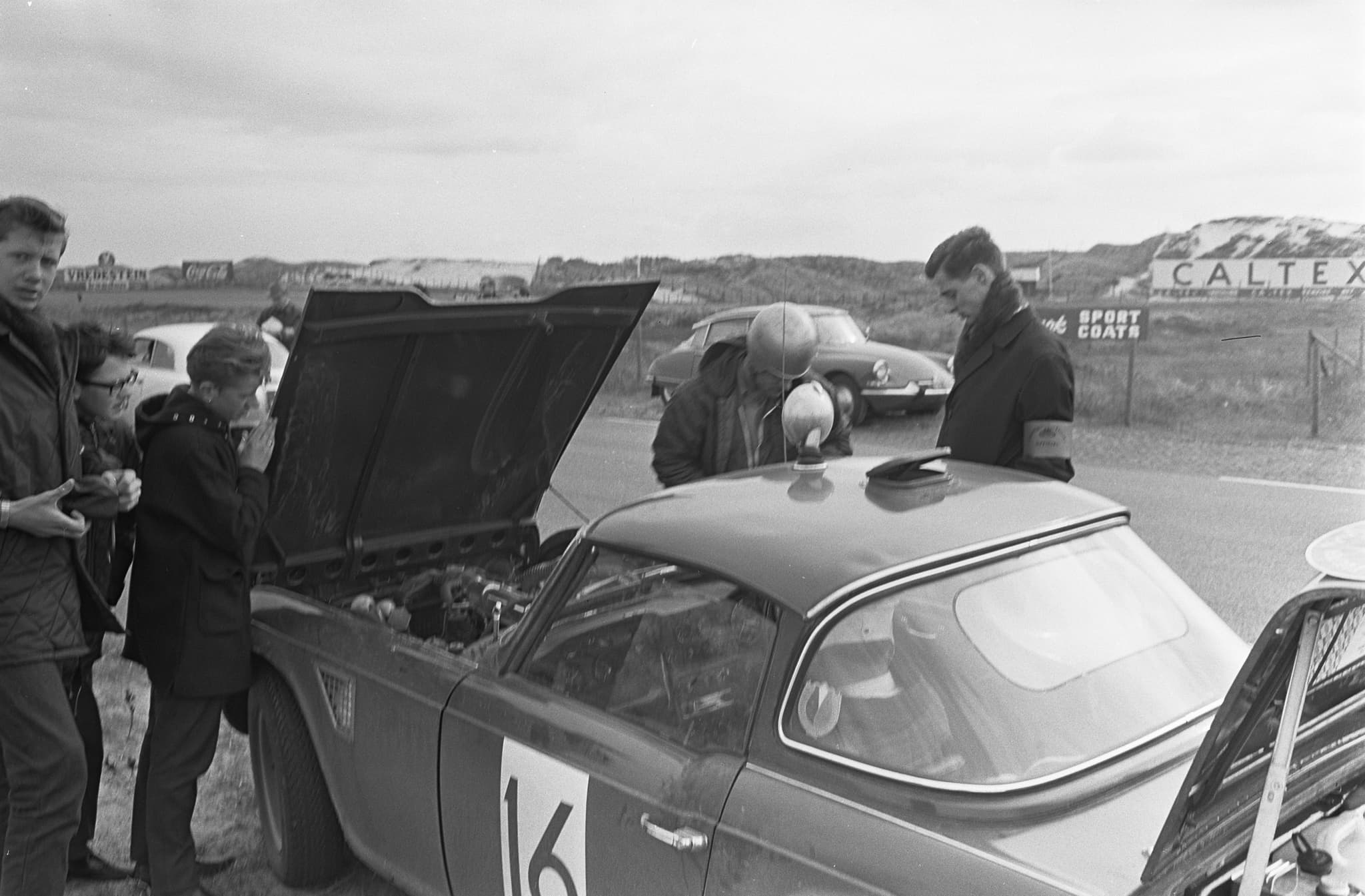
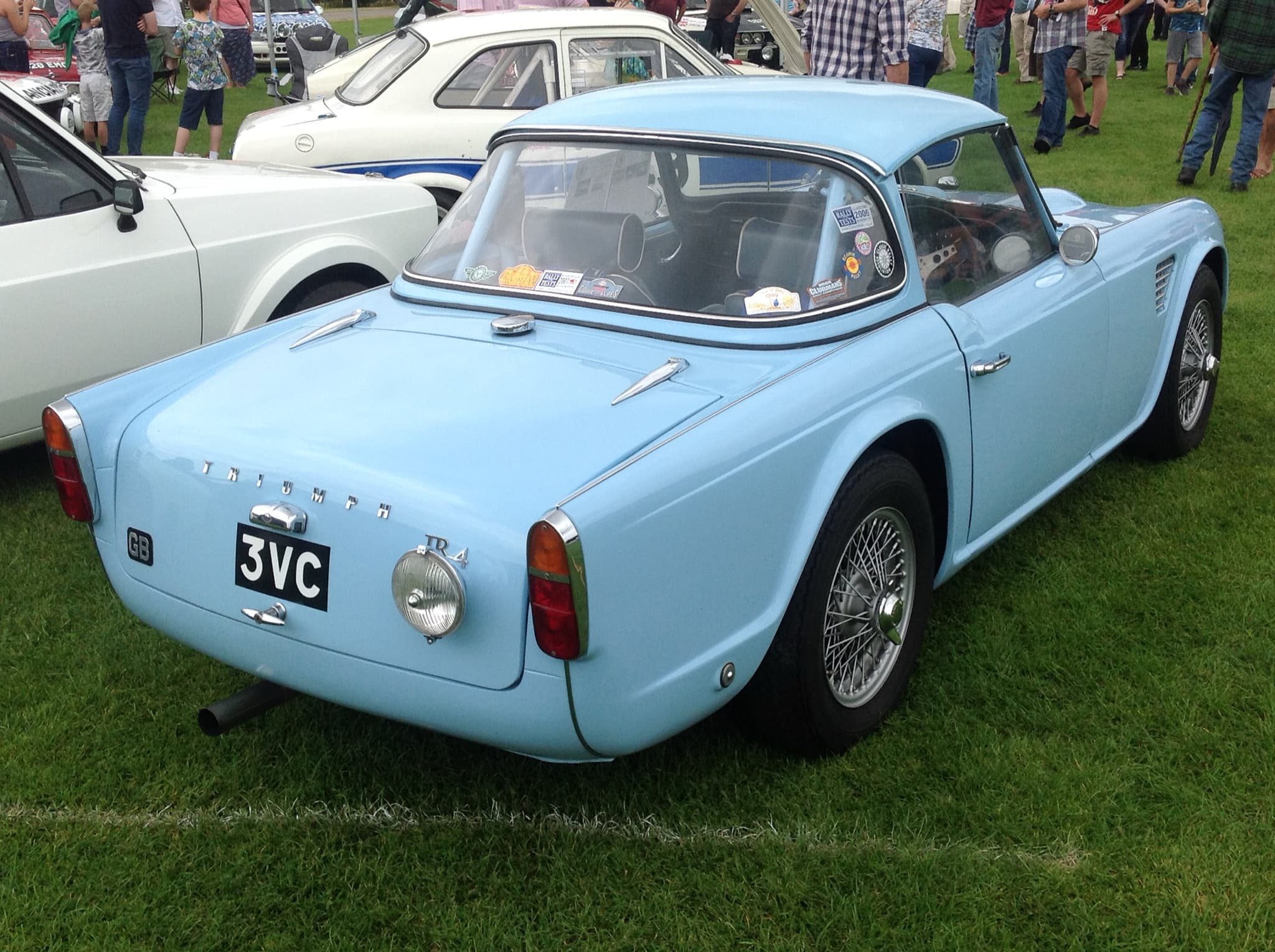
In Europe the TR4 brought Triumph back to rallying. Leyland had closed the competitions department, yet in 1962 the works sent four TR4s rallying, powder blue and registered 3 VC to 6 VC, under a young development engineer, Graham Robson. Mike Sutcliffe won a Coupe des Alpes on the 1962 Alpine Rally and finished 4th overall, and the team ran through 1963, after which the works rallied Spitfires and 2000 saloons instead. In 1964 three works TR4s, rebuilt on new left-hand-drive frames, crossed Canada on the Shell 4000 Rally.
In America the TR4 did better still in racing: Bob Tullius was the SCCA's national champion in his class three years running, from 1962 to 1964. At Sebring in March 1963 three TR4 hardtops entered by the Standard-Triumph Motor Company and prepared by Kas Kastner finished 1st, 2nd and 4th in their class, and that year Kastner became the company's competitions manager.
In its May 1964 issue Car and Driver reported that its readers had voted the TR4 the best GT or sports car under $3,000, with a third more votes than the MGB, and the importer's club recorded the award being presented on the Triumph stand at the New York Auto Show.source 19source 13source 12source 2source 10source 11source 20source 21source 22source 23source 24source 25
The TR4A, 1965–67
The TR4's weak point was its ride: on rough roads its live axle drew the same complaint from testers year after year. The cure, independent rear suspension, was already on Standard-Triumph's smaller cars and was being developed for the 2000 saloon, Ate Up With Motor notes.
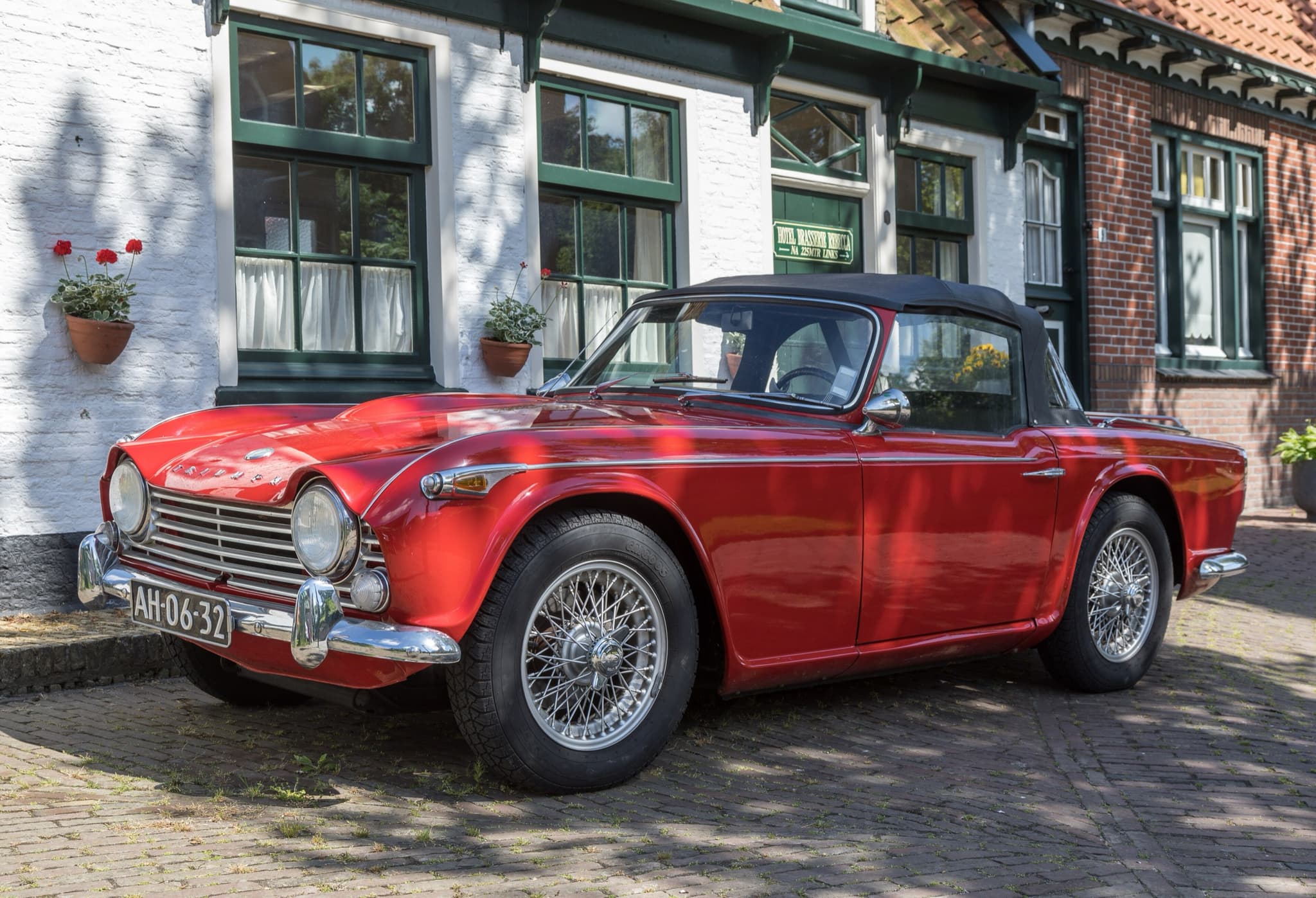
The TR4A, built from January 1965 and offered to the press for a drive to the Geneva show that March, put it under the TR4's body. Its frame was new, though the wheelbase was not, and it carried semi-trailing arms and coil springs at the back. Outside it had a grille of horizontal bars and lamps moved to the front wings, with a chrome strip running back through the doors; inside, a walnut dashboard as standard and a handbrake between the seats.
America nearly refused it. The new suspension threatened to lift the American price past $3,000, a psychological barrier that worried Genser-Forman, which handled Triumphs in the north-east. Standard-Triumph agreed to a second TR4A for American and Canadian buyers, its new frame fitted with the TR4's old axle and leaf springs, and charged extra there for independent suspension. The TR4A's page weighs what is known of how many were built.
The TR4A arrived as its rivals multiplied. By 1966 a buyer could choose the Spitfire Mk II, the MGB, the Sunbeam Alpine Series V and, from late that year, Triumph's own GT6, and Ate Up With Motor writes that the TR4A's edge in performance was shrinking. Barred from the SCCA's production classes in 1965, the TR4A raced in D Modified instead, and Charlie Gates won that national championship in the car Kastner built; at Sebring in 1966 three TR4As finished 1st, 2nd and 3rd in their class.source 2source 4source 26source 27source 28source 29source 30
The end of the four, 1967
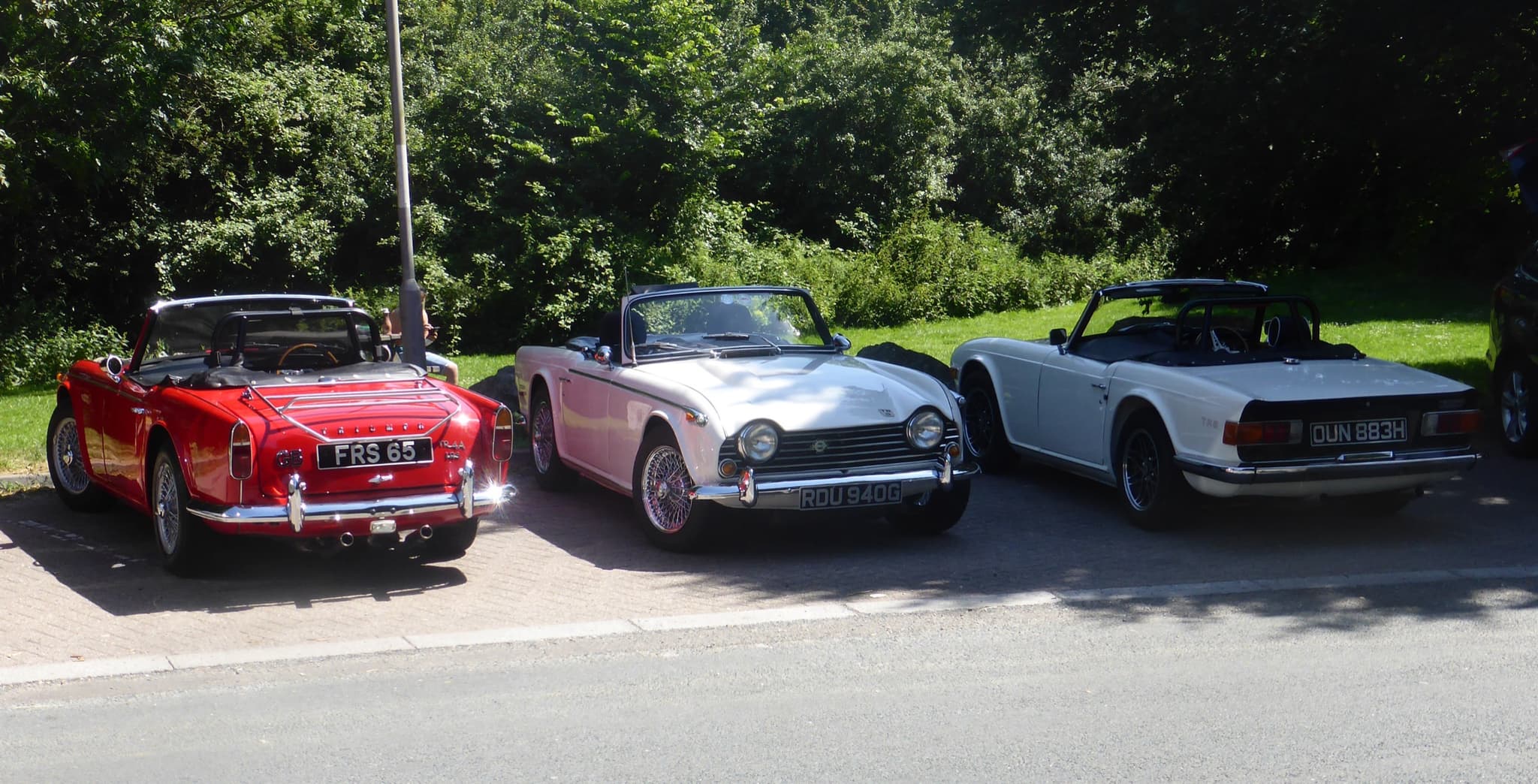
The wet-liner TR ended in July 1967. Rimmer's dated number list makes CTC78684 the last TR4A, on 11 July, one day after CTC78687, which carries the highest number. The TR250, for America, began the same week, with CD1 on 11 July, and the TR5 followed with CP2 on 29 August: both kept the TR4A's re-touched body and its frame, with a six-cylinder engine. In Robson's account the four was shut out by North America's new rules, and had no development left in any case.
Even then the body was not finished. The TR6 of 1968 kept its centre section, under new ends by Karmann. TR4 vs TR5 compares the TR4 with what came before it and after.source 4source 31source 32
Rivals
At its launch the TR4's price sat about midway between an MGA roadster's and an Austin-Healey 3000 Mk II's, by Ate Up With Motor's reckoning. Of two softer rivals nearer its price, Aaron Severson writes:
Rivals like the Sunbeam Alpine or Alfa Romeo Giulietta Spider were a little more livable on real-world roads, but neither stood a chance against the Triumph in any sort of direct performance contest.
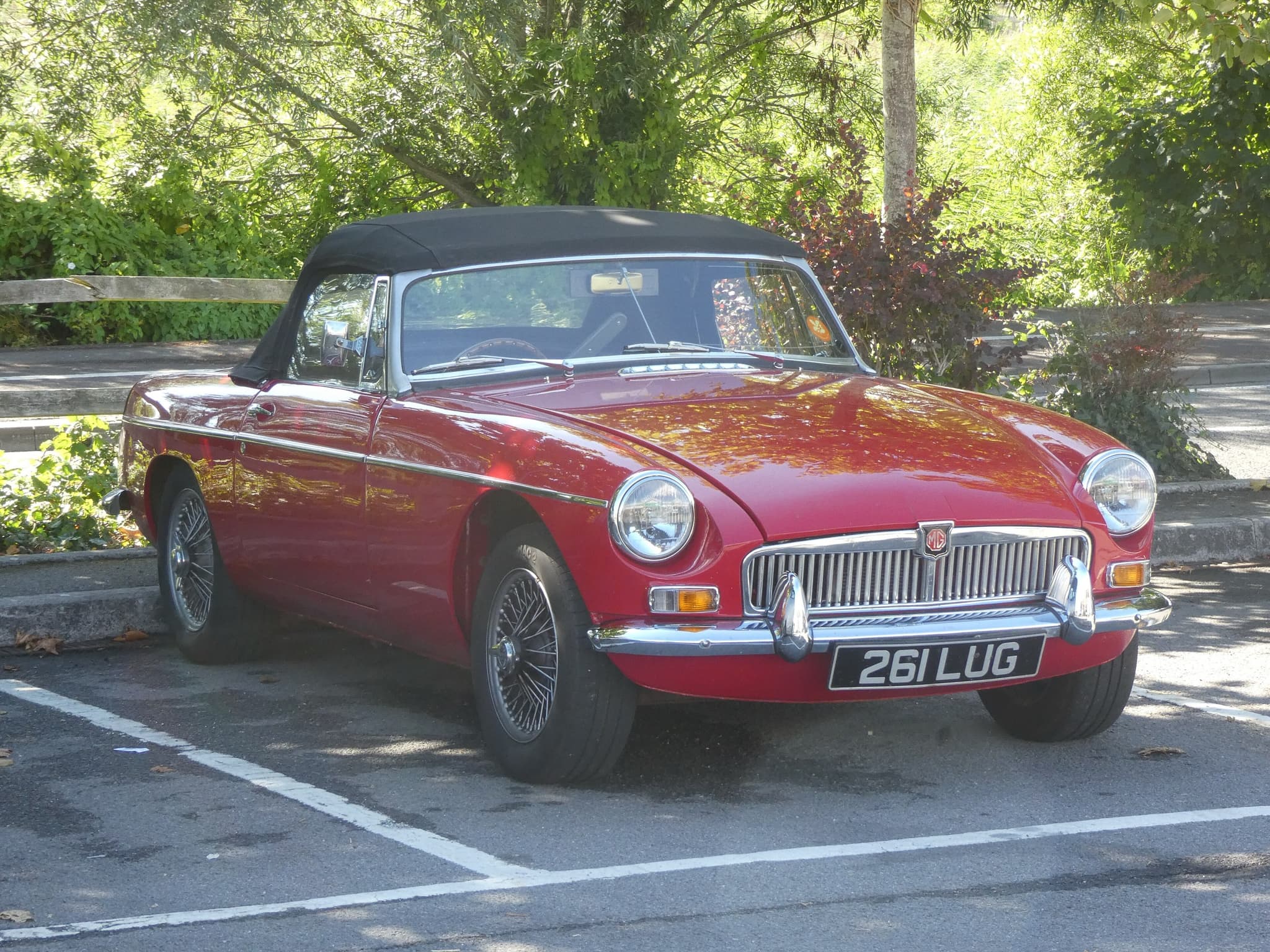
The MGB, launched in 1962, was the newest rival, and it was the cheaper car whether the two are compared before purchase tax, before the tax cut of late 1962 or after it. Its much smoother ride, G. William Krause writes, made the TR4's harsh one look worse. The TR4 still won the readers' poll of 1964. In November 1966 Motor Sport thought that, on paper, Triumph's new GT6 seemed "a direct competitor to the TR4A".
The table gives the rivals as Motor Sport priced them, each at one date. Purchase tax was cut late in 1962, so prices from either side of the cut cannot be set against each other, and the TR4's own prices are on its version page.
| Rival | When | Price with purchase tax | Where |
|---|---|---|---|
| Austin-Healey Sprite and MG Midget | November 1962 | "well under £700" | Motor Sport, London show survey |
| Triumph Spitfire 4 | November 1962 | £730 | Motor Sport, London show survey |
| Lotus Elan | November 1962 | £1,499 | Motor Sport, London show survey |
| MGB | September 1963 | £834 6s, or £690 before tax | Motor Sport, road test |
| Triumph GT6 | November 1966 | £985 | Motor Sport, London show report |
On the track, at Sebring in 1963, a works Morgan Plus 4 finished 3rd in the TR4s' class, between the TR4s that were 2nd and 4th. What the sources read cannot give is a ranking by sales: none gives the TR4's sales year by year, or its rivals'.source 2source 33source 34source 35source 36source 3source 24source 37source 23
Assembly outside Britain
Almost every TR4 and TR4A was built in Coventry. The introduction to Rimmer's parts catalogue says that a few TRs were assembled from kits in South Africa and Australia, but no source read places a TR4 among them.
In Belgium, TR4As were assembled from kits sent out from Coventry, and the Vintage Triumph Register says an ICTC prefix on the commission number shows that a car was built there. No source read names the plant; it was probably the one at Mechelen (Malines) that assembled Spitfires.
In Italy, Ducati held the distribution of Triumph cars from 1 September 1962, under a licence that also covered the making of parts and assembly. A Swiss classic-car magazine reports that only about 20 TR4s are said to have been assembled at Ducati's Borgo Panigale works, with indicators on their front wings for the Italian rules; no source read says whether they had commission numbers of their own.source 4source 38source 39
In culture
Police forces bought TR4s. According to an insurer's history of the car, Southend-on-Sea Borough Police bought one in May 1962 as its fast pursuit car, with a Winkworth gong, two-note horns, a radio, a spotlamp and overdrive, and ran it about 1,600 km (1,000 miles) a week; Manchester's city police used TR4s too. The same account records that Revington TR later restored the Southend car.source 40
Sources
Every source the site cites is on the sources page.
- Primarymade at the time, by the maker or by people who were there
- Referenceserious later work: clubs, specialists, magazines, books
- Databaseresults and listings, entry by entry
- Uncheckedencyclopaedias and enthusiast sites: cited beside a good source, named in the sentence, or marked Unchecked
- Ian Nicholls, "The Rover-Triumph story": "1960: expansion" and "1961: Leyland's takeover", AROnline, 7 Jul 2019, 1960 page: board minutes of 18 July 1960, as quoted; 1960 page: the board of 19 September 1960, Zebu dropped, the live axle kept for Zest, £676,000; 1960 page: Speke, 9 February 1960; Spurrier, 14 and 16 November 1960. 1961 page: 31 January 1961; 8 March 1961, £933,000; 1961 page: the board dismissed on 17 August, announced 21 August; the announcement the day after 31 August. aronline.co.uk/history/the-rover-triumph-story/1960-expansion Reference
- Aaron Severson, "Grandfather's Ax: The Many Evolutions of the Triumph TR4, Part 1: TR4 and TR4A", Ate Up With Motor, 22 Oct 2012, "Rescued by Leyland"; the final blend of Zest and Zoom; "Grandfather's Ax": the successor planned from mid-1957; Dick, Webster and Belgrove; "an outside businessman"; the Dream Car; the Herald in under 24 hours; the Z code names; Zest, Zoom, the twin-cam and the TRS; the late-1960 brief and "a Goldilocks version"; the two "TR3B" prototypes; "Rescued by Leyland": the suppliers, Speke, the slump and £600,000 a month; tooling almost £1 million; the wind-up windows; pilot production in August 1961; Speke shells, Canley assembly; Dick replaced by Markland; the price over the TR3A's; "The Triumph TR3B": the distributors' fears; "concerns … proved unfounded"; the Strombergs and cost; "never quite matched the popularity of the TR3A"; the works team withdrawn; "The Independent TR4": the ride, IRS on every other model by 1962, the new frame, Genser-Forman and the $3,000 barrier; "TR4A and Triumph Super Stock": the rivals of 1966; the price position at launch; the Alpine and Giulietta Spider; the shrinking edge by 1966. ateupwithmotor.com/model-histories/triumph-tr4-tr4a/view-all Reference
- G. William Krause, The Illustrated History of Triumph Sports and Racing Cars, CarTech, 2017, p. 52, the TR4's nose and Zest; pp. 42–45, a chance meeting at a motor show; pp. 44–52, Zest, Zoom and the two-piece hardtop; p. 56, the MGB's smoother ride. static.summitracing.com/global/images/technicalarticles/sad-ct596.pdf Reference
- Graham Robson (essay "15 Years of Evolution"), Triumph TR2 – TR3/3A, TR4/4A – TR5, TR250 1953–1968 Parts & Accessories Catalogue, Rimmer Bros, edn 2.1 (source code TR2512), Part 1, p. 7, the last TR4A, July 1967; p. 7, CT1 built 18 July 1961; p. 5, the TR3B; pp. 6–7, TSF and TCF numbers, 3,331 built, in Birmingham; p. 5, the new chassis frame; the cheaper TR4A for the USA and Canada; p. 6, Robson on the four and the new rules; p. 7, CTC78684 and CTC78687, CD1 and CP2; p. 1, the catalogue's introduction: a few CKD cars in South Africa and Australia. rimmerbros.com/images/PDFs/TR2-5_Part1.pdf Reference
- Bruno Dwinger, "Geschichte, Typenkunde und Kaufberatung: Standard-Triumph TR4, TR5/TR250 – 'die Michelotti Autos'", TR-Register Deutschland, 2009, 13 pp. (PDF), p. 1, the name TR4 from 1956; Raymond Flower; three months and £3,000. tr-register.de/wp-content/uploads/2025/08/Kaufberatung-TR4-und-TR5-und-TR250.pdf Reference
- Graham Robson, "Harry Webster – My Technical Mentor", Moss Motoring (Moss Motors), 12 Jun 2019, Michelotti found through Raymond Flower. mossmotoring.com/harry-webster-my-technical-mentor Reference
- The Daily Telegraph, "Harry Webster" (obituary), 9 Feb 2007, Webster "discovered" Michelotti. telegraph.co.uk Reference
- Revington TR, "ZOOM Prototype" (TR Derivatives and Prototypes), Zoom page: built by Vignale in 1959; the hardtop car and the TRS moulds. revingtontr.com/the-tr-series/tr-derivatives/zoom-prototype Reference
- Dennis May, "Technical Report" on the TR-4 (cover story), Car and Driver, Oct 1961, pp. 19–23, pp. 19–20, the body and the twin-cam Le Mans car; p. 19, the E-Type comparison; p. 23, an addition to the line. Primary
- Motor Sport, "XXXIe Rallye Monte Carlo", Mar 1962, p. 17, p. 17, "the Leyland regime disbanded the Competitions Department"; p. 17, Robson to organise a team of TR4s. motorsportmagazine.com/archive/article/march-1962/17/xxle-rallye-monte-carlo Primary
- Julian Balme, "TR4: Triumph's rally underdog", Classic & Sports Car, 4 Aug 2021, the competitions department closed in 1961; the four cars, powder blue; the 1962 Alpine; the Shell 4000 rebuilds. classicandsportscar.com/features/tr4-triumphs-rally-underdog Reference
- Arthur Kelly (the VTR's TR4 consultant), "TR4": "A Historical Overview of the TR4" and the TR4 commission-number page, Vintage Triumph Register, production history, CT1; 1962 brake change; the walnut dash. vintagetriumphregister.org/tr4 Reference
- TR Drivers Club, "Triumph TR4", "Standard Triumph's new Speke plant in Liverpool"; calipers and geometry; seats from body 15076CT; the Stromberg change. trdrivers.com/articles21/triumphtr4.html Reference
- Revington TR, "TR4", bodies from Speke. revingtontr.com/the-tr-series/tr4 Reference
- Bill Boddy ("W. B."), "The new Triumph TR4", Motor Sport, Sep 1961, p. 17, p. 17, the launch description; initial production for North America; price at the London Show; p. 17, "it will replace the TR3". motorsportmagazine.com/archive/article/september-1961/17/the-new-triumph-tr4 Primary
- Motor Sport, "The Paris Motor Show 1961", Nov 1961, p. 36, p. 36, the TR4 at the Paris show. motorsportmagazine.com/archive/article/november-1961/36/the-paris-motor-show-1961 Primary
- Gordon Wilkins, "Report: New Triumph TR-4", Motor Trend, Dec 1961, pp. 64–66, pp. 64–66, "designed primarily for the North American market"; the ride. Primary
- Triumph Sports Owners Association, Triumph Sports Owners Association Newsletter, September 1961 (TR-4 special issue), Sep 1961 (vol. VII no. 9), the factory's announcement to American owners; "an addition to the Triumph line, not a replacement". vintagetriumphregister.org/tsoa/TSOASep61.pdf Primary
- Revington TR, "TR4: Technical Specification Change Points", CT6429, CT11308, CT16350, CT16801. revingtontr.com/the-tr-series/tr4/technical-specification-change-points Reference
- Triumph Sports Owners Association, Triumph Sports Owners Association Newsletter, March 1964, Mar 1964 (vol. 10 no. 3), p. 2, the 1962 E Production title. vintagetriumphregister.org/tsoa/TSOA0364.pdf Primary
- Triumph Sports Owners Association, Triumph Sports Owners Association Newsletter, September 1963, Sep 1963 (vol. 9 no. 8), D Production title, 1963; Kastner competitions manager. vintagetriumphregister.org/tsoa/TSOA0963.pdf Primary
- Triumph Sports Owners Association, Triumph Sports Owners Association Newsletter, November 1964, Nov 1964, D Production title, 1964. vintagetriumphregister.org/tsoa/TSOA1164.pdf Primary
- racingsportscars.com, Sebring 12 Hours 1963, results, results, GT 2.5; GT 2.5: the works Morgan Plus 4 third. racingsportscars.com/results/Sebring-1963-03-23.html Database
- Triumph Sports Owners Association, Triumph Sports Owners Association Newsletter, April 1964, Apr 1964 (vol. 10 no. 4), Car and Driver readers' poll, from its May 1964 issue; the readers' poll and the MGB. vintagetriumphregister.org/tsoa/TSOA0464.pdf Primary
- Triumph Sports Owners Association, Triumph Sports Owners Association Newsletter, January 1965, Jan 1965 (vol. 11 no. 1), the award at the New York Auto Show. vintagetriumphregister.org/tsoa/TSOA0165.pdf Primary
- Motor Sport, "Matters of moment, April 1965", Apr 1965, p. 11, p. 11, the drive to Geneva, March 1965. motorsportmagazine.com/archive/article/april-1965/11/matters-of-moment-april-1965 Primary
- TR Drivers Club, "Early Cars: The TR4A", TR4A body, trim and dashboard. trdrivers.com/earlycars/tr4A.html Reference
- Gordon H. Jennings, "Kas Kastner and his Super Triumph", Car and Driver, Feb 1966, pp. 48–49, 92, pp. 48–49, the TR4A refused for production racing; D Modified. kaskastner.com/feb66.pdf Primary
- Triumph Sports Owners Association, Triumph Sports Owners Association Newsletter, March 1966, Mar 1966 (vol. 12 no. 3), Gates's 1965 D Modified championship. vintagetriumphregister.org/tsoa/TSOA0366.pdf Primary
- racingsportscars.com, Sebring 12 Hours 1966, results, results, GT 2.5: 1st to 3rd. racingsportscars.com/results/Sebring-1966-03-26.html Database
- Revington TR, "Technical Specification Change Points" (TR6), the TR6's retained centre section. revingtontr.com/the-tr-series/tr6/technical-specification-change-points Reference
- TR Register, "Triumph TR6 Buyers Guide" (facts sheet), the TR6 body: Karmann's new ends. tr-register.co.uk/resources/buyers-guide/triumph-tr6 Reference
- Motor Sport, "Matters Of Moment, November 1962", Nov 1962, p. 9, the November 1962 show survey and its prices. motorsportmagazine.com/archive/article/november-1962/9/matters-of-moment-november-1962 Primary
- Bill Boddy ("W.B."), "The 1.8-litre M.G.-B", Motor Sport, Sept 1963, p. 22, p. 22, price line. motorsportmagazine.com/archive/article/september-1963/22/the-18-litre-mg-b Primary
- Motor Sport, "New cars from Rover, B.M.C., Ford and Fairthorpe", Oct 1962, p. 16, p. 16, the MGB at its launch. motorsportmagazine.com/archive/article/october-1962/16/new-cars-from-rover-bmc-ford-and-fairthorpe Primary
- Motor Sport, "The Triumph TR4: a rugged British sports car", with the data panel "The Triumph TR4 hard-top", Jan 1963, pp. 9–10, pp. 9–10, the TR4's prices after the tax cut. motorsportmagazine.com/archive/article/january-1963/9/the-triumpth-tr4 Primary
- Motor Sport, "Earls Court debuts", Nov 1966, p. 38, p. 38, the GT6 against the TR4A. motorsportmagazine.com/archive/article/november-1966/38/earls-court-debuts Primary
- Vintage Triumph Register, "TR4A" (history, change points and yearly output, buyer's and spotter's guides, numbering), numbers section: the ICTC prefix. vintagetriumphregister.org/tr4a Reference
- Paul Krüger, "Was der Triumph TR4 mit Ducati zu tun hat", zwischengas.com, 18 Jun 2022, Ducati's licence from 1 September 1962; about 20 TR4s; wing indicators. zwischengas.com/de/blog/2022/06/18/Was-der-Triumph-TR4-mit-Ducati-zu-tun-hat.html Reference
- Lancaster Insurance, "An Arresting Triumph – Southend-on-Sea Police's TR4", 5 Jul 2019, the Southend car: May 1962, its equipment and mileage; Manchester's TR4s; the restoration. lancasterinsurance.co.uk/news/2019/july/05/an-arresting-triumph-southend-on-sea-polices-tr4 Unchecked