Triumph TR4 vs TR5
The TR4's place in one line of Triumphs: the TR3A it grew from, the TR4A it became, and the six-cylinder TR5 and TR250 that took over its body in 1967.
TR-3 partisans need not lament the coming of the big 4. It is an addition to the line, not a replacement for the 3.
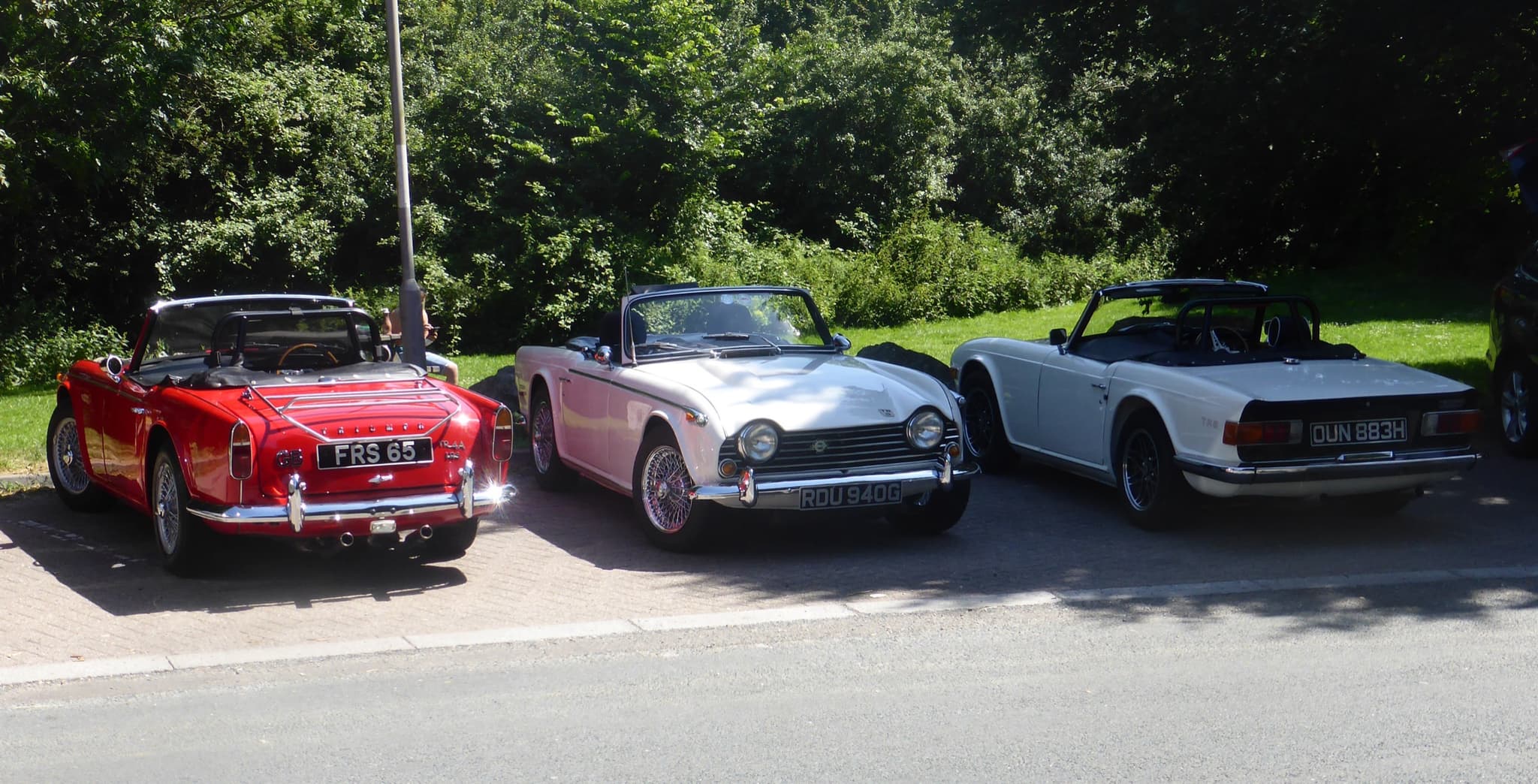
The TR4 was one step in a line of Triumphs that ran from the TR2 of 1953 to the TR6, and each step kept more of the last than its new name suggested. This page follows the line through the TR4's own years: from the TR3A it grew out of, through the TR4 and the TR4A, to the TR250 and the TR5, which from July 1967 put a six-cylinder engine in the TR4A's body.source 1source 2source 3
The lineage table
| Item | TR3A | TR4 | TR4A | TR5 PI | TR250 |
|---|---|---|---|---|---|
| Built | September 1957 to October 1961 or January 1962, as the TR3's sources differ | July 1961 to January 1965 | January 1965 to July 1967 | August 1967 to September 1968 | July 1967 to September 1968 |
| Commission numbers | From TS22014; the last is disputed | CT1 to CT40304 | CTC50001 or CTC50006 to CTC78687; live-axle cars from CT50001 | CP2 to CP3101 | CD1 to CD8594 |
| Markets | Mainly North America | Mainly North America | Every market; the live-axle car for North America only | Every market but North America | North America only |
| Body | The TR2 and TR3 shape, with a wide grille, cutaway doors and sidescreens | Michelotti's, with wind-up windows | The TR4's, with a new grille, side strips and badges | The TR4A's, with new rear lamps and badges | The TR4A's, with a stripe across the nose |
| Frame | The TR2 and TR3 ladder frame | The TR3A's, widened at the front | New, for independent rear suspension | The TR4A's | The TR4A's |
| Rear suspension | Live axle on leaf springs | Live axle on leaf springs | Semi-trailing arms and coil springs, or a live axle in North America | Semi-trailing arms and coil springs | Semi-trailing arms and coil springs |
| Steering | Cam and lever | Rack and pinion | Rack and pinion, slower | Rack and pinion | Rack and pinion |
| Engine | Wet-liner four; the larger size an option from 1959 | The same four, the larger size standard | The same four, with a new manifold and exhaust | Six, 2,498 cc, with Lucas fuel injection | Six, 2,498 cc, with twin Stromberg carburettors |
| Gearbox (transmission) | Four speeds, no synchromesh on first | Four speeds, all with synchromesh | The same | The same | The same |
Rimmer's production table counts 58,236 TR3As, 2,947 TR5s and 8,484 TR250s, and 3,331 of the stop-gap TR3B of 1962, which put the TR4's gearbox, and on all but the first few hundred cars its engine, into the TR3A's body; the TR4's and the TR4A's totals are in the line-up. The last TR4A and the first TR250, CD1, were built on the same day, 11 July 1967, and the TR5 and TR250 ended on 19 September 1968, when the TR6 took their place.source 2source 4source 5source 1source 3source 6
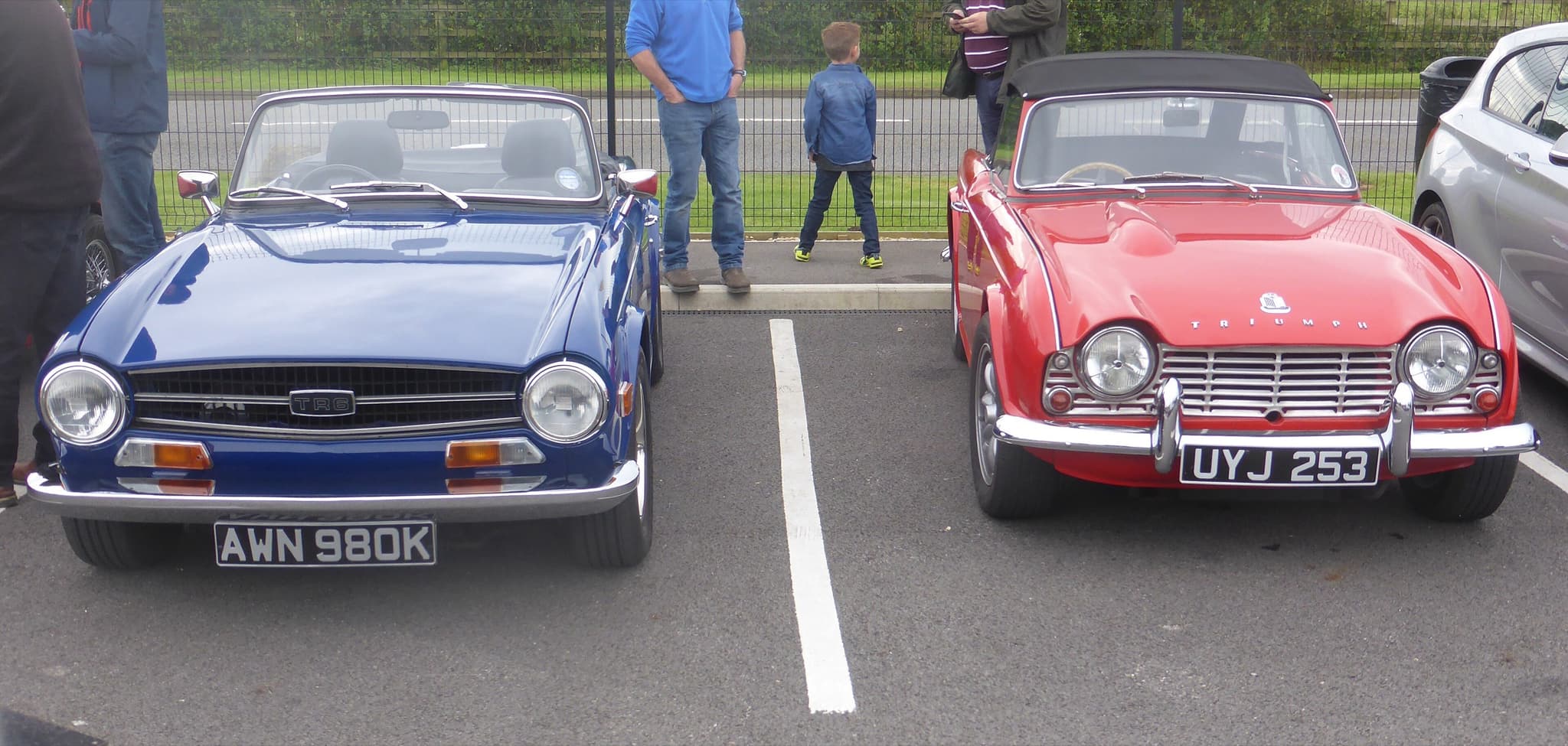
TR3A to TR4: what changed, what stayed
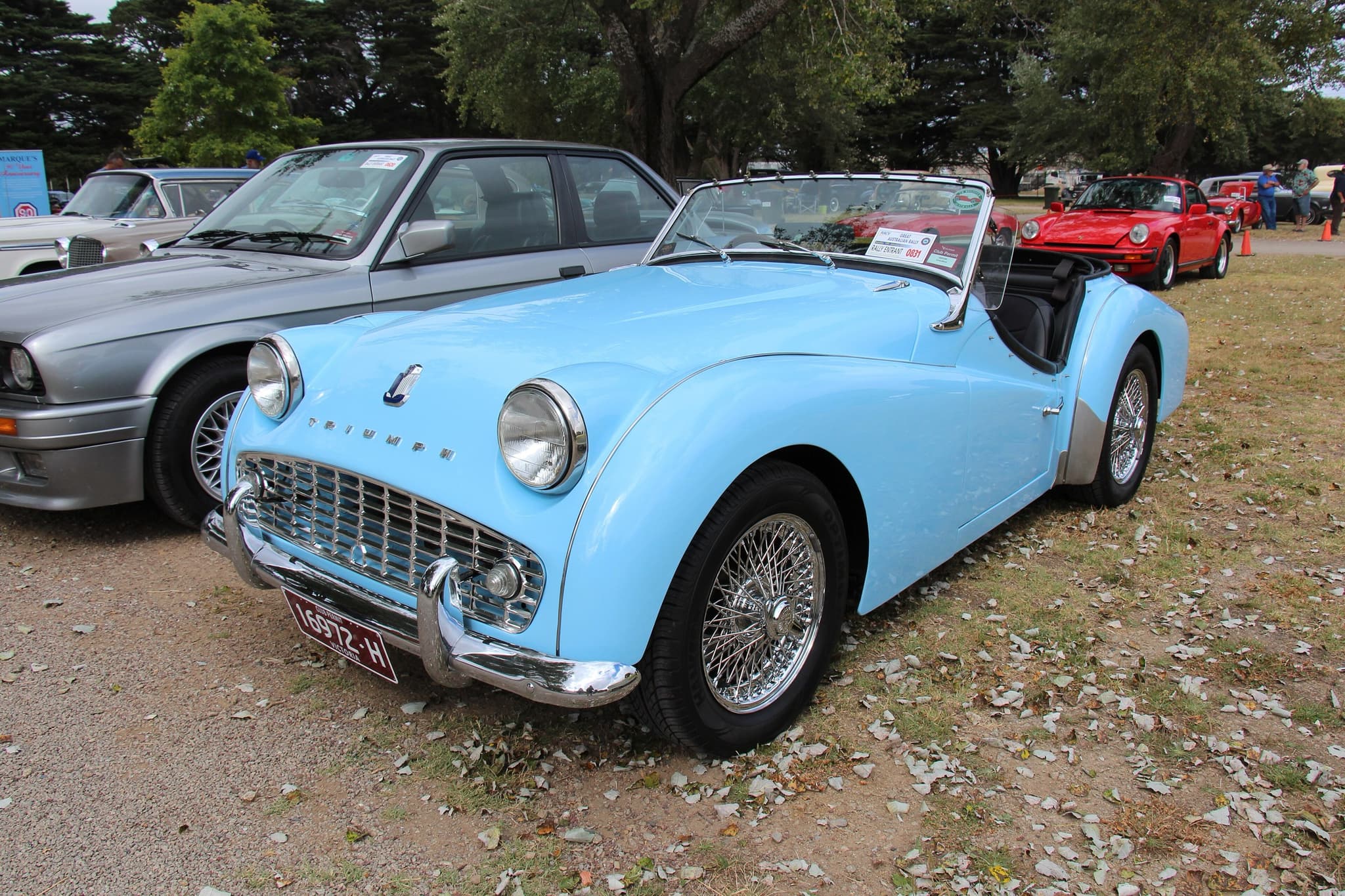
The body changed completely: Michelotti's design brought wind-up windows, face-level vents, a curved windscreen (windshield) fixed to the body, a front-hinged bonnet (hood) and more room in the boot (trunk). Underneath, the changes were few: the tracks widened, the frame's side members were stiffened and the damper settings softened, the steering became rack and pinion, and first gear gained synchromesh, Car and Driver reported. Standard now was the larger engine that TR3A buyers had had to order as an option.
Much stayed. The frame kept its design and its wheelbase, the front suspension its wishbones and coil springs, and the back its live axle on leaf springs with lever-arm dampers. The front brakes were discs, as before. Of the engine, Car and Driver reported that only the bore and the compression changed, the stroke, head, ports and camshaft staying as they were, and the first TR4s even had seats of the TR3's pattern.
The new car was heavier and, Ate Up With Motor writes, "no faster than the TR3A": the extra power was spent on a slightly larger frontal area and more weight, by an amount the sources dispute; the TR4 page gives their figures. It rode and handled better. Car and Driver's Dennis May found "all the old directness and immediacy of response without the TR-3's characteristic twitchiness", and Bill Boddy of Motor Sport, looking back on 1961, "a softer, less 'hoppy' ride than its famous predecessor". It cost £51 more than the last TR3A before tax, and $174 more in America, by Ate Up With Motor's reckoning. Only in America did the TR3A's body carry on, through 1962, as the TR3B, because the distributors were unsure of the new car.source 1source 7source 2source 8source 9source 3source 10
TR4 to TR4A
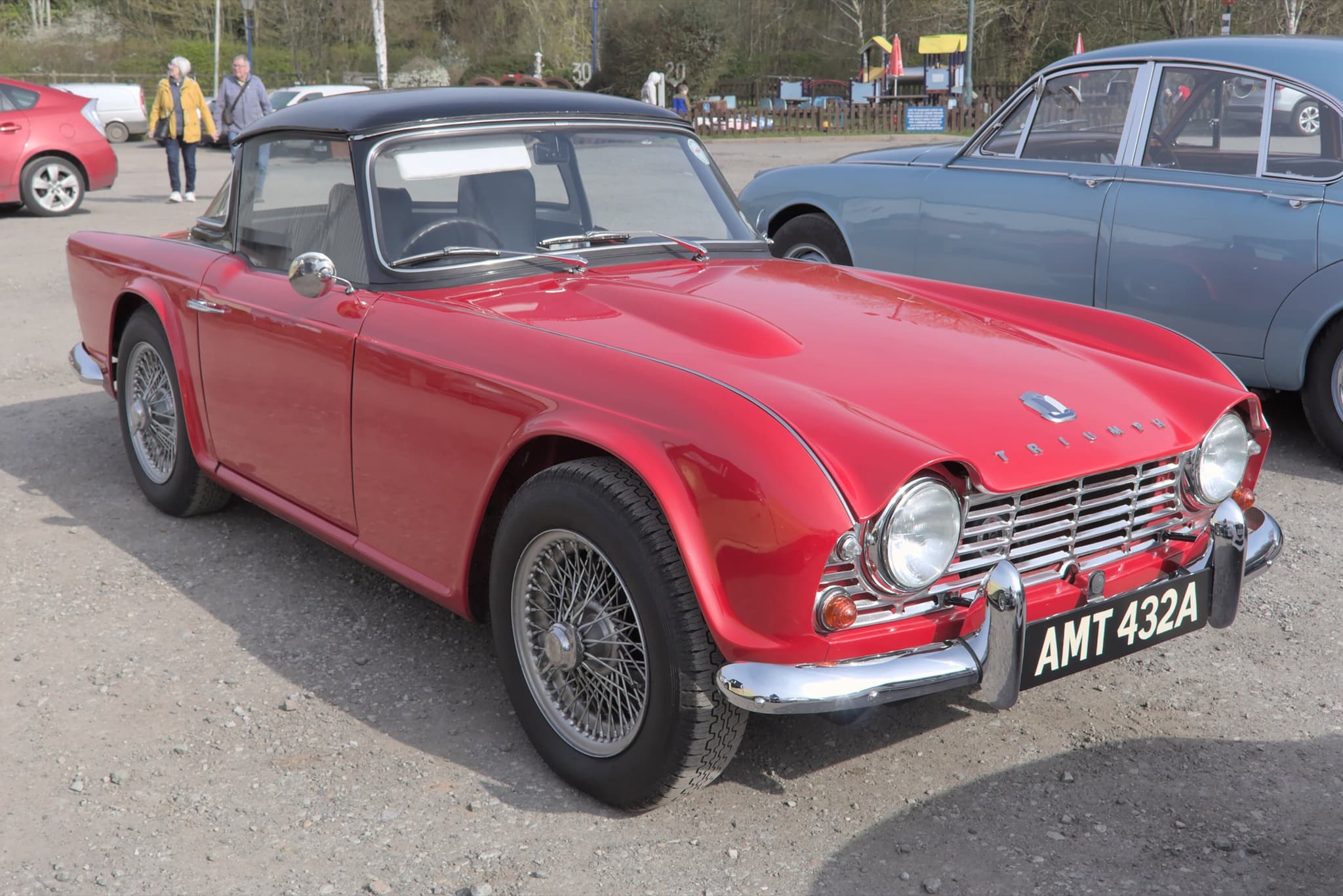
The TR4A of 1965 kept the TR4's body shell, doors, windscreen and boot, its engine and its gearbox, and changed what lay beneath: a new frame on the old wheelbase, with the rear wheels sprung independently, though the North American base model stayed on a live axle. The front suspension gained travel, the steering was slowed, and a new manifold and exhaust added a little power. It was heavier too, by about 50 kg (112 lb) on the factory's figures that Ate Up With Motor quotes. The TR4A's new face, cabin and hood (soft top) are described on the TR4A page.source 3source 11source 12source 2
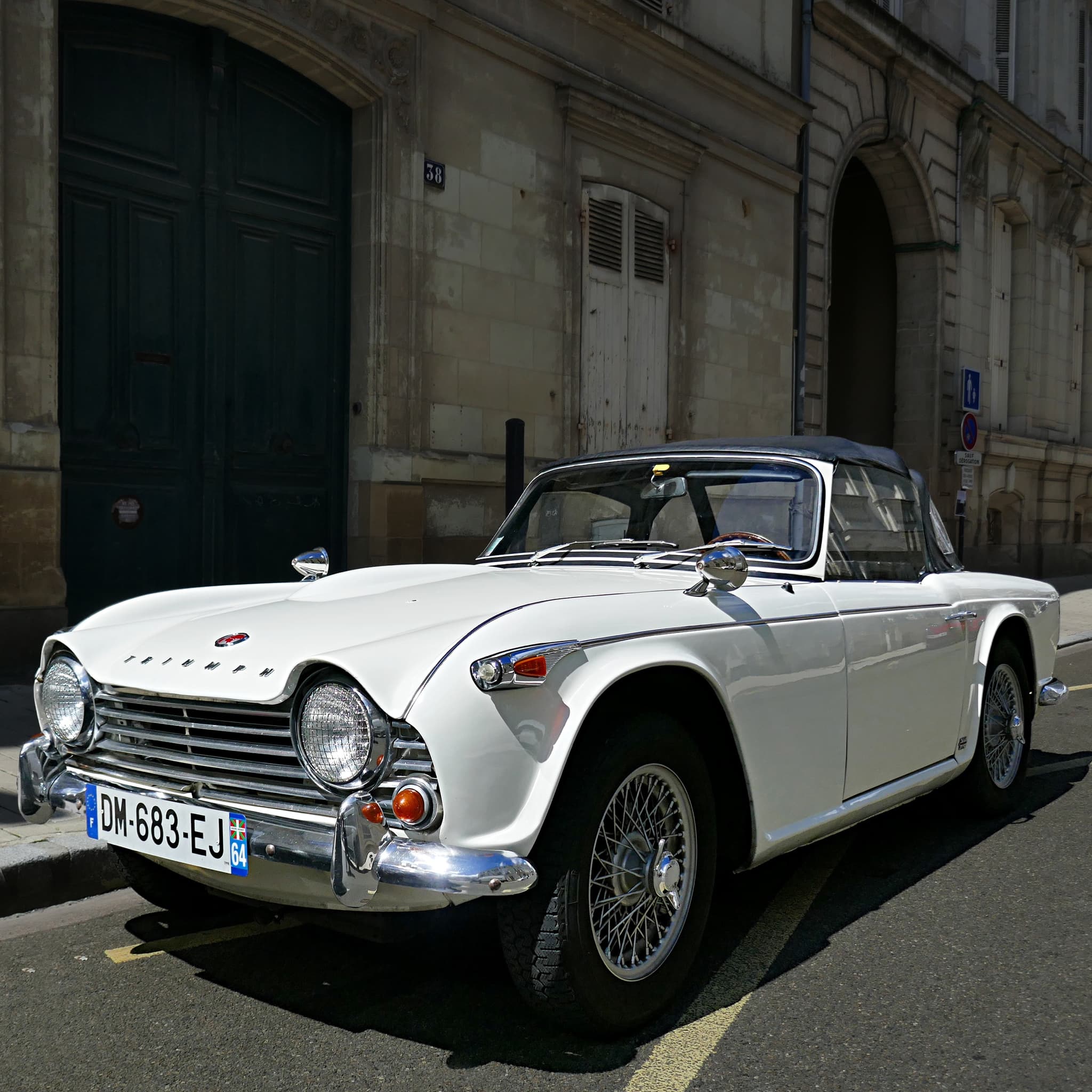
TR4A to TR5 and TR250
By 1967 the TR4A was, in Ate Up With Motor's words, "no longer the screaming bargain it had once been. To remain competitive, it would need more power." The German TR Register says Standard-Triumph decided in 1965 to end the era of the wet-liner four, and that the new car was called Wasp inside the works. America's new rules on emissions settled it:
… the dear old 'four' could not meet the new rules, and was in any case at the end of its development life.
The new engine was the Triumph 2000's six, its stroke lengthened from 76 to 95 mm. The TR5 had Lucas fuel injection and was sold everywhere but North America; the TR250, for North America only, had twin Stromberg carburettors and a milder camshaft, and was never fuel-injected. Both kept the TR4A's body almost unchanged, the German guide says, with smaller rear lamps under the boot lid and inner wings shaped for the six; Robson adds the TR250's stripes across the nose. The frame and the independent rear suspension stayed, with radial tyres and servo-assisted brakes. G. William Krause writes that the TR5 weighed "only 28 pounds more than the 4A", and found the TR250 smoother and more tractable than the four but disappointing in power.
The six cost more: the TR250 was over $300 dearer than a TR4A IRS in America, Ate Up With Motor notes. Motor Sport, testing a TR5 PI in August 1968, found that it "has its imperfections, but is a vast improvement over the immediately preceding TR4A".
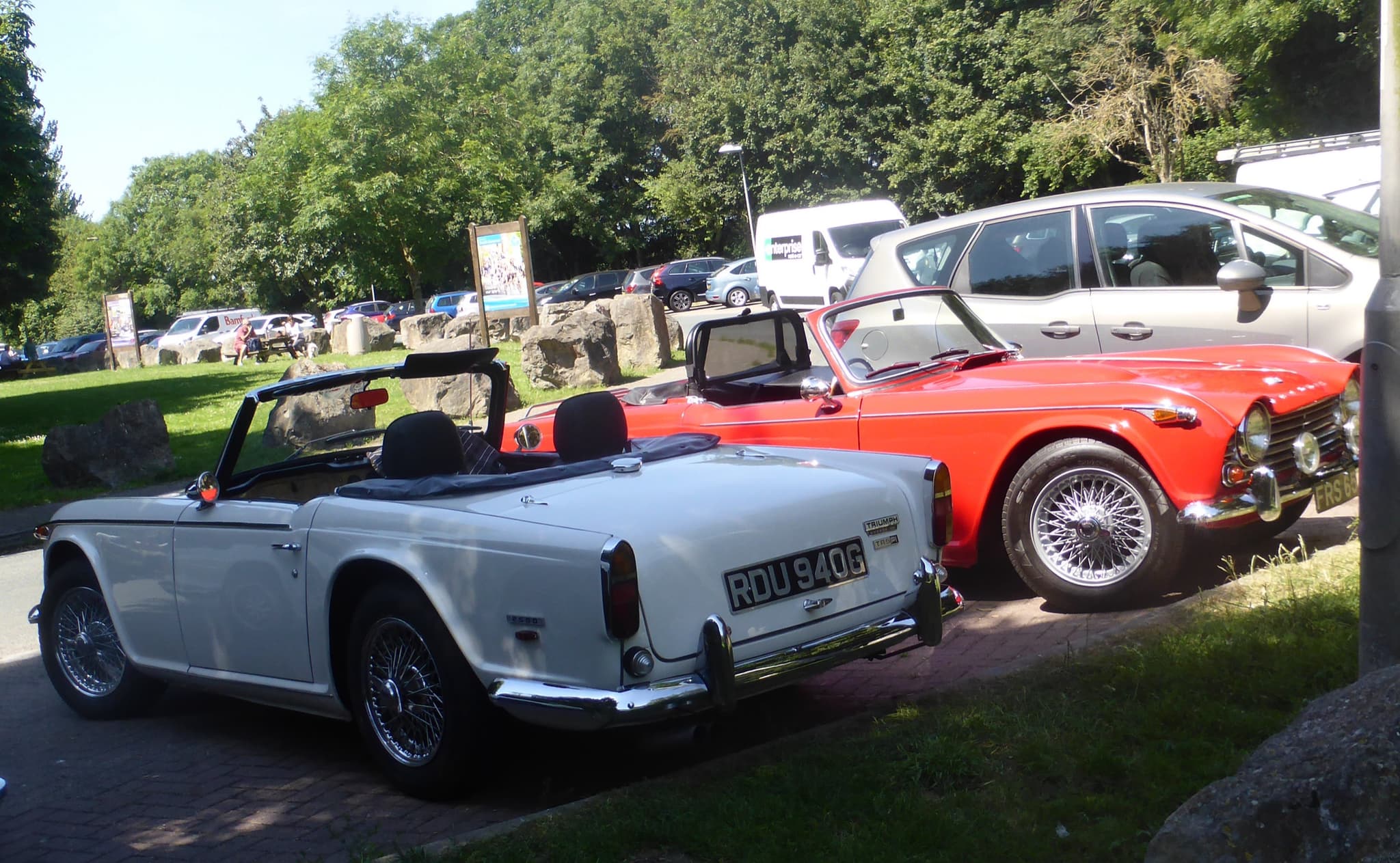
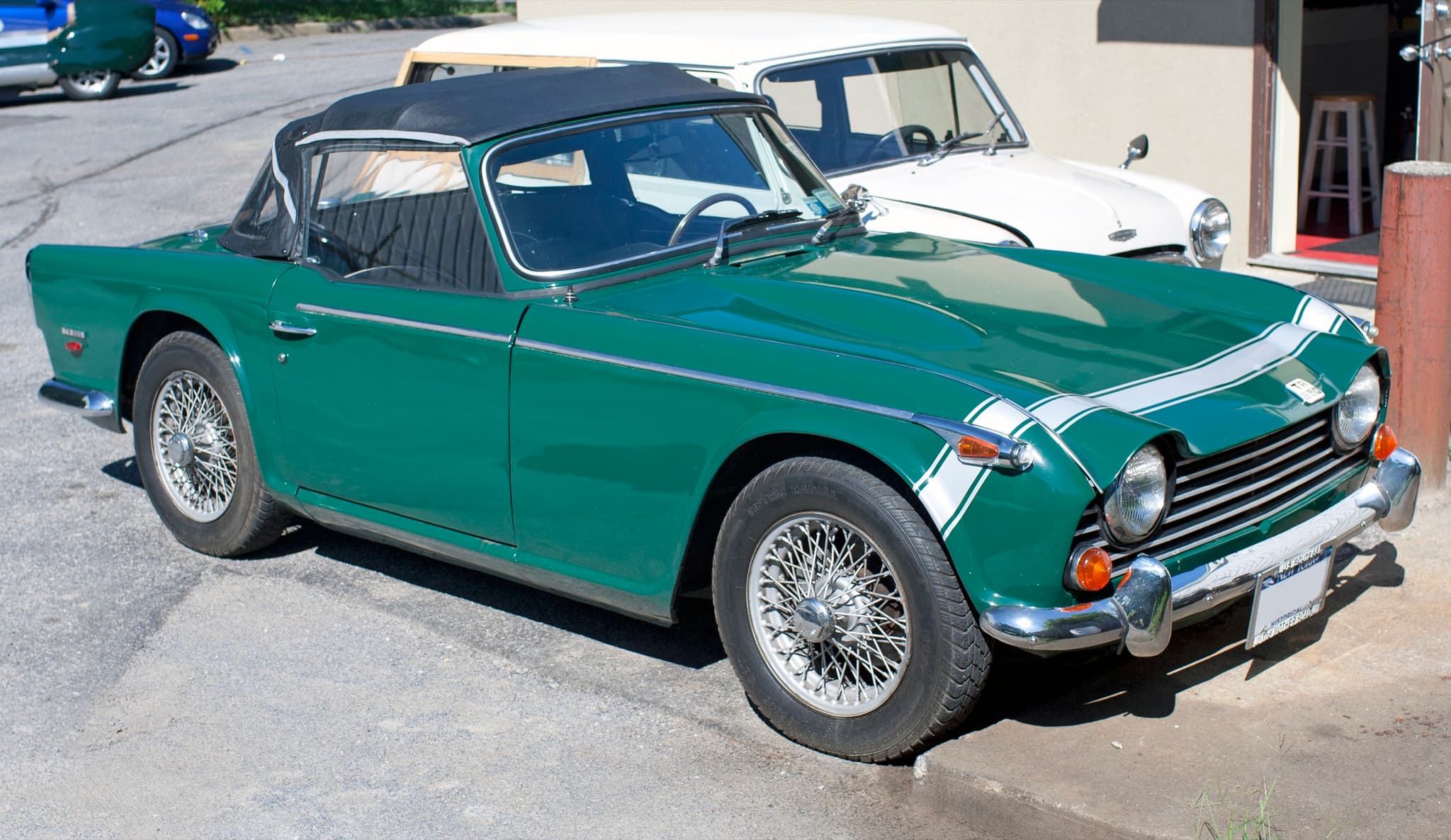
Which to choose
No source read ranks them: the choice is a buyer's. An insurer's guide of 2024 finds "a purity about" the TR4 and a more civilised ride and handling in the TR4A, and the six-cylinder cars have much more power. The TR Register's guide holds that the frames up to the TR4's were the strongest of all, and that the six-cylinder cars suffer more from rust in the rear of the frame than the TR4A does. The buying guide sets out what to check.source 16source 17
Sources
Every source the site cites is on the sources page.
- Primarymade at the time, by the maker or by people who were there
- Referenceserious later work: clubs, specialists, magazines, books
- Dennis May, "Technical Report" on the TR-4 (cover story), Car and Driver, Oct 1961, pp. 19–23, p. 23, "an addition to the line, not a replacement for the 3"; the TR3's steering and gearbox; pp. 19–23: the changes; the engine left as it was but for bore and compression; the TR3-pattern seats; "all the old directness". Primary
- Graham Robson (essay "15 Years of Evolution"), Triumph TR2 – TR3/3A, TR4/4A – TR5, TR250 1953–1968 Parts & Accessories Catalogue, Rimmer Bros, edn 2.1 (source code TR2512), Part 1, pp. 5–7, Robson's essay and the number list; pp. 5–7: the production table (TR3A, TR3B, TR5, TR250) and the number list (TS22014, CT1–CT40304, CTC50006–CTC78687, CP2–CP3101, CD1–CD8594, the end on 19 September 1968); p. 5, the TR4 on the TR3A's frame; p. 5, the new frame; the live axle for North America; p. 6, Robson on the four and the TR250's stripes; p. 7, CD1, CP2 and the end on 19 September 1968. rimmerbros.com/images/PDFs/TR2-5_Part1.pdf Reference
- Aaron Severson, "Grandfather's Ax: The Many Evolutions of the Triumph TR4, Part 1: TR4 and TR4A", Ate Up With Motor, 22 Oct 2012, the TR4's lineage; the TR4A's frame and the live-axle cars; "no faster than the TR3A"; the frontal area and weight; £51 and $174 more; "The Independent TR4": the frame, the suspension, the steering, the engine, 112 lb by factory figures; "To remain competitive, it would need more power". ateupwithmotor.com/model-histories/triumph-tr4-tr4a/view-all Reference
- Arthur Kelly (the VTR's TR4 consultant), "TR4": "A Historical Overview of the TR4" and the TR4 commission-number page, Vintage Triumph Register, the last TR3A, October 1961, as the TR3's sources differ. vintagetriumphregister.org/tr4 Reference
- Bruno Dwinger, "Geschichte, Typenkunde und Kaufberatung: Standard-Triumph TR4, TR5/TR250 – 'die Michelotti Autos'", TR-Register Deutschland, 2009, 13 pp. (PDF), pp. 3–6, the TR5 and TR250 engines and bodies; pp. 3–6: the decision of 1965 and "Wasp"; the six; the bodies; the brakes. tr-register.de/wp-content/uploads/2025/08/Kaufberatung-TR4-und-TR5-und-TR250.pdf Reference
- Revington TR, "TR4A: Technical Specification Change Points", CTC50001; CT50001. revingtontr.com/the-tr-series/tr4a/technical-specification-change-points Reference
- Gordon Wilkins, "Report: New Triumph TR-4", Motor Trend, Dec 1961, pp. 64–66, pp. 64–66, the body and the frame. Primary
- TR Register, "Triumph TR4 / TR4A Buyers Guide", "Mechanically based on the TR3A, but with modified chassis". tr-register.co.uk/resources/buyers-guide/triumph-tr4-4a Reference
- TR Drivers Club, "Triumph TR4", the frame and the gearbox. trdrivers.com/articles21/triumphtr4.html Reference
- Bill Boddy, "My Year's Motoring", Motor Sport, Feb 1962, p. 29, p. 29, "a softer, less 'hoppy' ride". motorsportmagazine.com/archive/article/february-1962/29/my-years-motoring Primary
- TR Drivers Club, "Early Cars: The TR4A", the TR4A's body, hood and cabin. trdrivers.com/earlycars/tr4A.html Reference
- Vintage Triumph Register, "TR4A" (history, change points and yearly output, buyer's and spotter's guides, numbering), the TR4A's changes. vintagetriumphregister.org/tr4a Reference
- G. William Krause, The Illustrated History of Triumph Sports and Racing Cars, CarTech, 2017, pp. 60–62: the TR250's camshaft; the TR5 "only 28 pounds more"; the TR250's power. static.summitracing.com/global/images/technicalarticles/sad-ct596.pdf Reference
- Aaron Severson, "Grandfather's Ax: The Many Evolutions of the Triumph TR4, Part 2: TR5, TR250, and TR6", Ate Up With Motor, 7 Nov 2012, the TR250's price against the TR4A IRS's. ateupwithmotor.com/model-histories/triumph-tr5-tr250-tr6/view-all Reference
- Doug Nye ("D. C. N."), "Road Test Report on a Sports Car: The Fuel-Injection Triumph TR5 PI", Motor Sport, Aug 1968, p. 26, the verdict; the price. motorsportmagazine.com/archive/article/august-1968/26/road-test-report-on-a-sports-car Primary
- Goodwood Classic Solutions, "Buyer's guide: Triumph TR4", 1 Nov 2024, "a purity about it"; the TR4A's ride. insurance.goodwood.com/buyers-guide/triumph-tr4-2 Reference
- TR Register, "Buyer Beware: TR6" (2 pp. PDF leaflet), p. 2, the strongest frames; rear-frame rust on the sixes. tr-register.co.uk/storage/Pages/tr6-buyer-beware.pdf Reference