Triumph TR4 Buyers Guide
Rust decides most TR4s and TR4As, so this guide starts with the metal, the body and the frame, before the TR4A's differential mounts, the mechanics and what a correct car has.
About the pictureA derelict TR4A-type car under brambles, not a frame on a lift
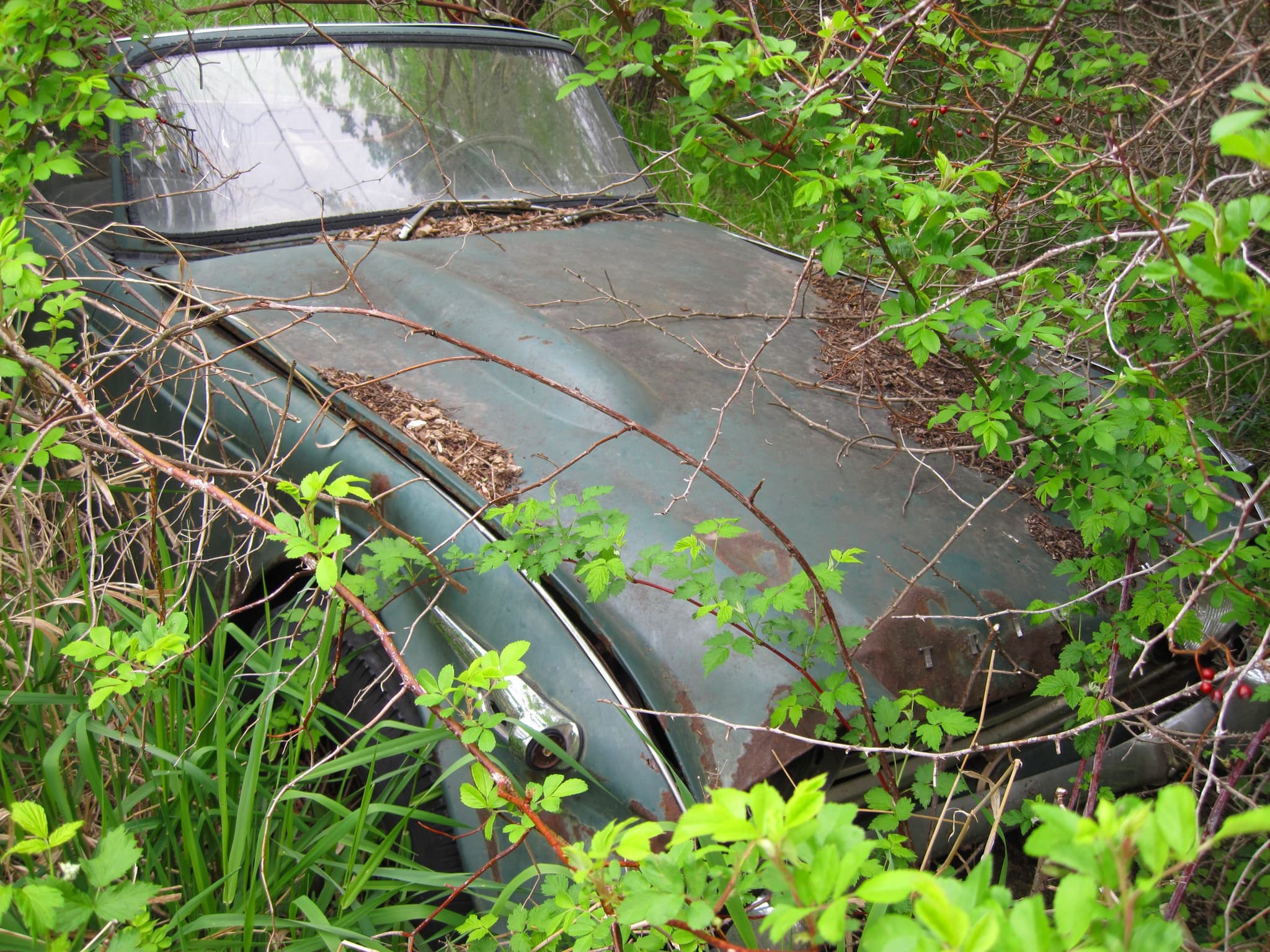
Most TR4s and TR4As are judged first by their metal. As an insurer's guide of 2024 puts it, "rust is always going to be the deciding factor on whether a TR4 lives or dies", and the German, British and American guides read agree that the body and the frame matter more than the engine or the gearbox (transmission). The most detailed guide found is the German TR Register's, written by Bruno Dwinger in 2009, and most of the checks below come from it, with the TR Register's own guide, the Vintage Triumph Register's and the insurer's.source 1source 2source 3source 4
Before you look
Assume the car has been restored at least once, the German guide advised in 2009, and that a closer look may show it needs doing again; the condition of the body against the asking price is the deciding question. Between a TR4 and a TR4A, the insurer's guide finds no great difference to weigh apart from the TR4A's independent rear suspension, which gives a better ride, though there are fewer TR4As to choose from. A left-hand-drive TR4A may have the live axle of the cars built for North America, so check which it is before buying: the commission number shows it, and identification explains how.
The German guide suggests taking a screwdriver, a small hammer, a magnet or a paint-thickness gauge, an angled mirror on a handle and a strong torch, and, better still, an experienced club member. Both the German and the American guides advise joining a club first, and the Vintage Triumph Register's sums up the alternative in an old proverb: "Marry in haste – repent at leisure."
Body
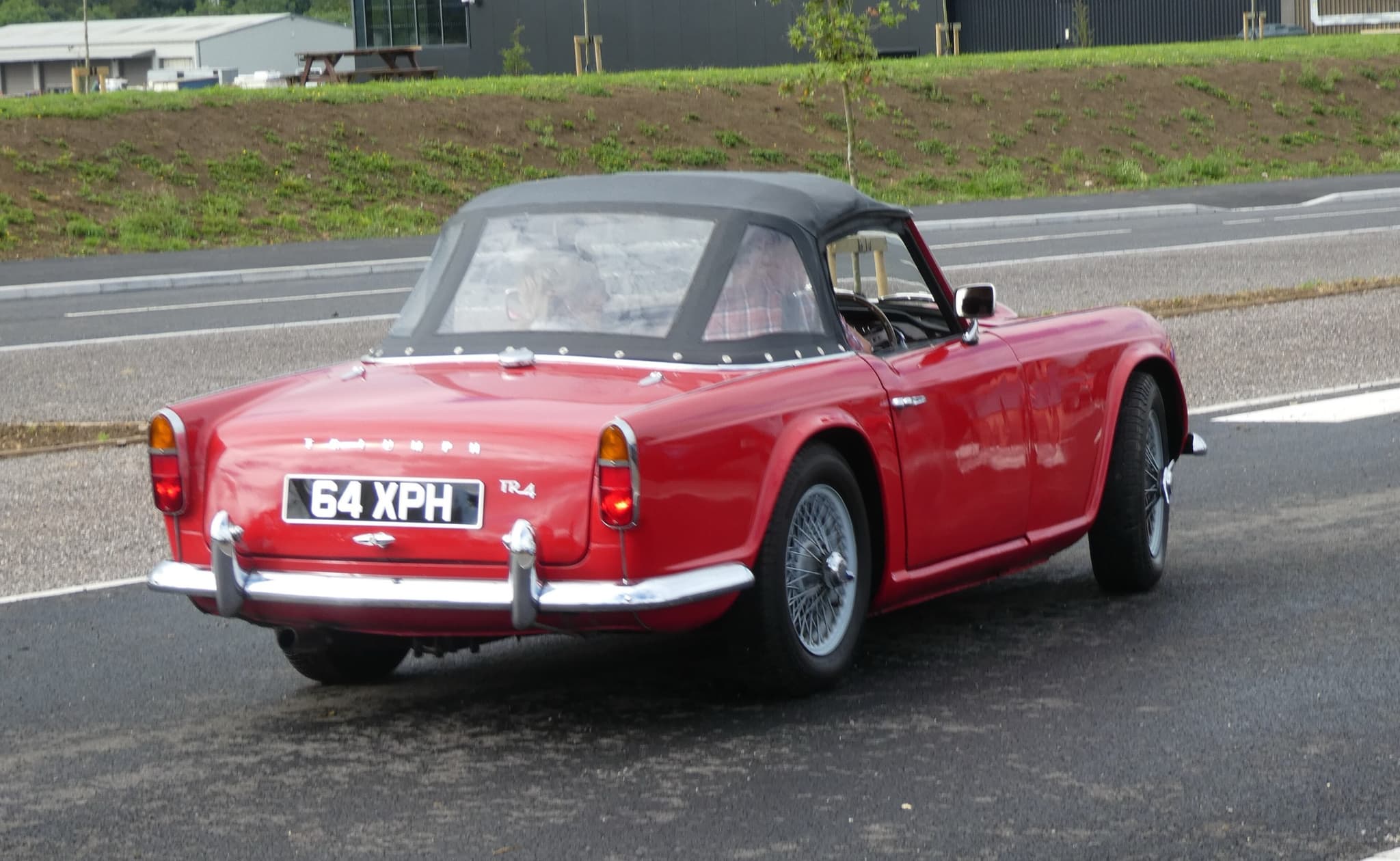
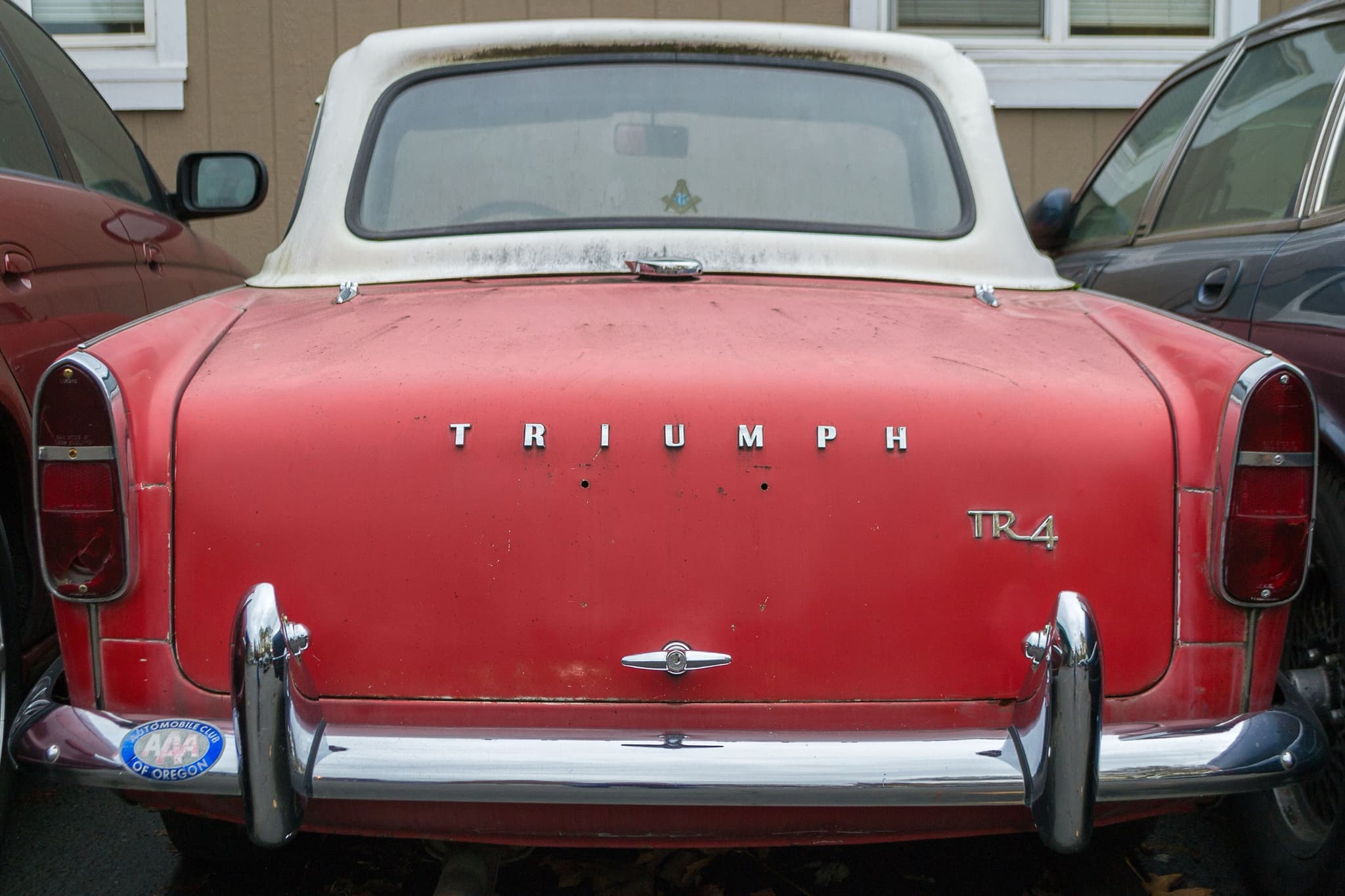
The TR4, TR4A, TR5 and TR250 share a body shell that the German guide calls largely identical, differing in their lamps and in the inner wings (fenders), shaped for the four or the six, so many panels interchange. Rust collects where dirt does, and the German guide's list is long:
The front
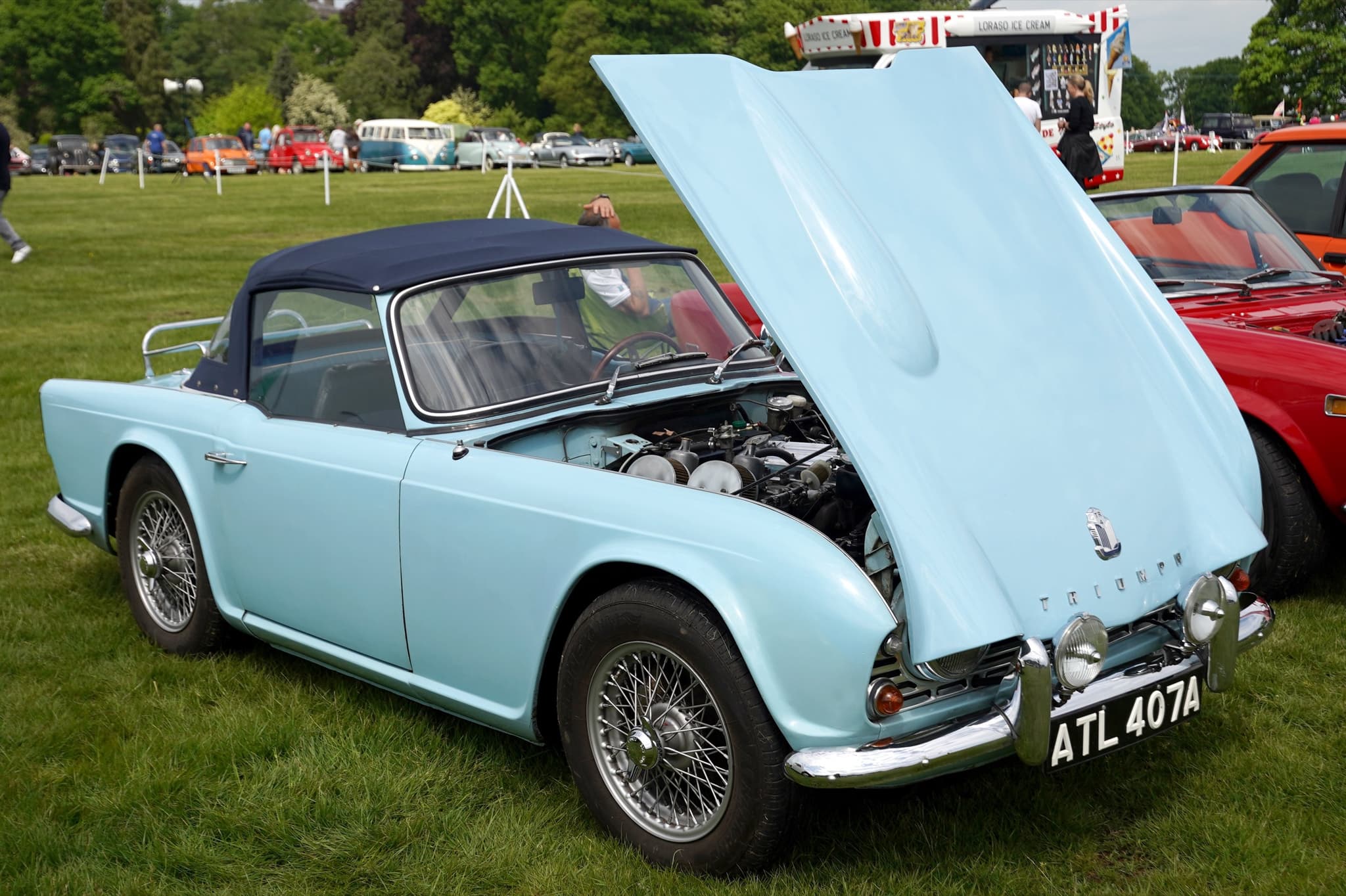
Around the headlamp mountings and the seams to the inner wings, and in the cavity behind the bulkhead where the inner wing, outer wing and door pillar meet. The bonnet (hood) itself rarely rusts, but it can buckle and crack about 20 cm from its rear edge, where it rests on its stops.
Under the battery
Almost always eaten through by acid: judge it only with the battery out. The TR Register's guide also warns about battery acid.
The doors
Lift each door at its rear edge to feel for worn hinges. Rust starts at the doubled front and rear edges and the bottom 10 cm, and a crack in the paint at either end of the window channel means the metal has cracked.
Sills (rocker panels), pillars and floors
The sills at the front, under the door pillar, and at the rear end; the pillar behind the door, which rusts from below at the seat-belt mounting; and the floor where it meets the sills and the bulkhead, and under the pedals, where wet shoes soak the carpet. Lift the carpets.
The rear
The edges of the rear wings behind the doors, where the metal is doubled; the tops of the rear wings; the bottom 10 cm of the boot (trunk) lid; and the corners of the rear panel under the bumper.
Accident damage
Look at the inner wings, the bonnet's hinge mountings and the front of the frame.
The Vintage Triumph Register adds the trailing ends of the front wings, where mud collects, and the upper rear arches, and reminds buyers that "The fore/aft strength of the car counts on solid sills". Uneven gaps at the doors' trailing edges point to a sagging sill or frame, or a poor restoration, the insurer's guide notes. Glass-fibre panels are not original; they were fitted when steel ones were scarce. The windscreen (windshield) frame is part of the structure, and the insurer's guide also says it is one of the few pieces of metalwork that cannot be bought new, though supply changes; look for filler in it. Check for leaks too, with the hardtop and without: the hardtop of Motor Sport's test car of 1963 let water in at a window joint.source 2source 3source 4source 1source 6
Frame (chassis)
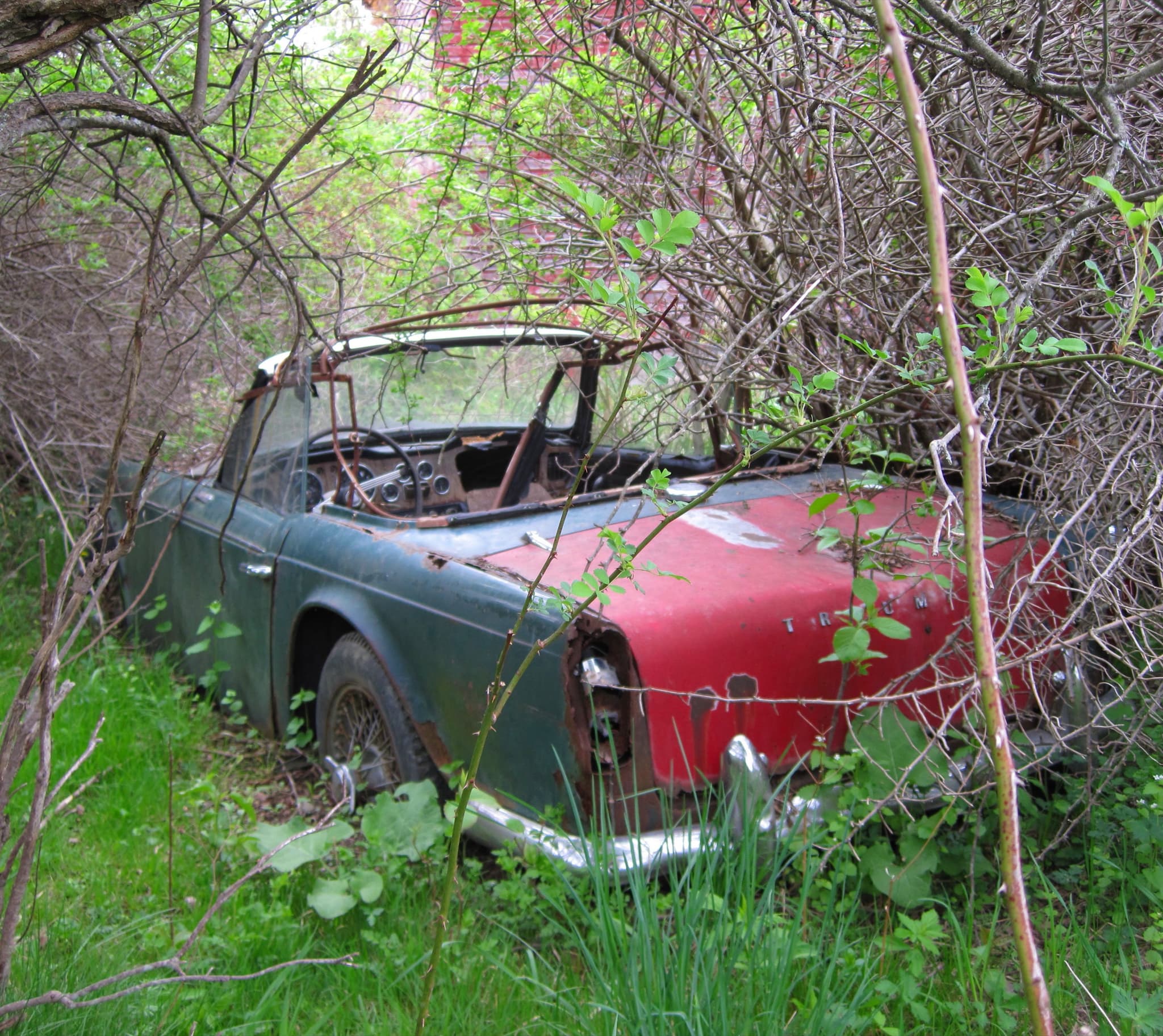
The TR2-6 were built on a very strong chassis, although the chassis used up to and including the TR4 were the strongest.
The TR4's frame is largely the TR3A's, with a wider front and new mountings for the steering rack. The TR4A's is new, and its rear half is the part to worry about: crossmembers welded between the side members, with reinforcing plates over and under them that rust from the inside, out of sight. The German guide warns that repairing them is laborious and that a reconditioned exchange frame may cost less. The TR Register's guide finds the front half of any TR frame most prone to damage in accidents.
The German guide's checks, from front to back: the front horns of the frame, for kinks and crushing; the brackets of the lower wishbones, which crack and break, especially from the TR4A on, tearing at the seam where they are welded to the steering-rack mounts, and which should be renewed with the cross-bracing that the TR6 had from the factory; the diagonal braces from the spring towers to the frame; the four side members, tapped for rust, though the middle of the frame is rarely damaged; and the rear end, for accident damage and rust where dirt has held water. The insurer's guide adds that the outriggers and rear suspension mounts "can be vulnerable". The Vintage Triumph Register has even come across a TR4 frame carrying TR4A panels.source 3source 2source 4source 1
Suspension and steering
On a TR4A with independent rear suspension, the differential hangs from two bridges between the rear side members on four studs, which the German guide calls too weak for the engine's torque. They tear out, and the damage can be judged only with the differential removed; a repair should add a reinforcement and a torque stay. The Vintage Triumph Register describes the warning sign:
Clunks from the rear under power may indicate worn, missing or broken differential mounts; usually the front right mount wears and then breaks, followed quickly by its left rear counterpart.
At the front, the wishbone bushes should have no play; the German guide noted in 2009 that polyurethane bushes were widely fitted and that new rubber ones were often poor. The stub axles turn in brass trunnions, which wear quickly if they are not lubricated, or are greased with something that hardens: the guide advises gear oil, and reads cracked old gaiters as a sign of long neglect. Split gaiters on the upper ball joints let water in. The steering rack develops play, and soft rubber mounts on the frame horns make the steering vague; firmer mounts were sold, the guide added.
The live axle of the TR4 and the American TR4A is robust, though the bushes in its spring eyes and damper links wear, and tired springs sag. The TR4A's independent rear suspension has universal joints that need lubricating, sometimes awkwardly, and wear noisily; the Vintage Triumph Register suggests the TR250's rubber gaiters over the inner joints. Its splined half-shafts could bind under power even when new. Wire wheels wear at their splines, hubs and spokes and should be checked regularly, and weak brakes, the Vintage Triumph Register finds, often mean badly adjusted rear drums.source 4source 2source 7source 8source 9
Engine
The wet-liner four is tough. The German guide expects normal valve-gear noise but no knocks or rattles, and no leaks except perhaps from the rear main seal on an engine without a modern lip seal. It suggests a compression test on a warm engine, with all four cylinders reaching 10 bar, and, more reliable, a leak-down test: air escaping at the oil filler points to the rings, at the carburettor to an inlet valve, at the exhaust to an exhaust valve, and coolant rising in the radiator to the head gasket. Brown foam under the filler cap may mean a failing head gasket, or only a car used for short trips. The Vintage Triumph Register's guide recommends the same tests, with the oil pressure read on a separate gauge and the coolant tested for exhaust gas.
The oil pressure, hot, should be over 3 bar (40 psi) with the engine at 3,000 rev/min, the German guide says; Motor Sport's test car of 1963 showed about 4.8 bar (70 lb/sq in) in normal running. Low pressure may be cured by a new oil pump and big-end shells, the Vintage Triumph Register notes. After about 5 km the temperature gauge should settle in the middle, and the German guide gives the opening temperature of the correct thermostat as 74 °C; overheating may mean a missing radiator shroud. Liners and pistons are made in a range of sizes, and the liners can be changed without reboring the block.source 2source 5source 6source 4source 10
Transmission
Every gear should engage without baulking. Listen for bearing noise: a grinding that stops when the clutch is pressed points to the gearbox's bearings, and a noise only with the pedal down to the release bearing. To test the clutch for slip, the German guide suggests trying to pull away in third gear with the handbrake on: a sound clutch stalls the engine. Overdrive should engage at once, dropping the revs by about a fifth; its faults may be electrical or simply low oil, the insurer's guide says, and the Vintage Triumph Register finds its adjustment simple. The insurer's guide thinks the gearboxes "a little more fragile" than the engines. At the differential flange the propshaft should have no more than 8 to 9 mm of free play, and the universal joints should be checked by hand.source 2source 1source 4
Interior and equipment
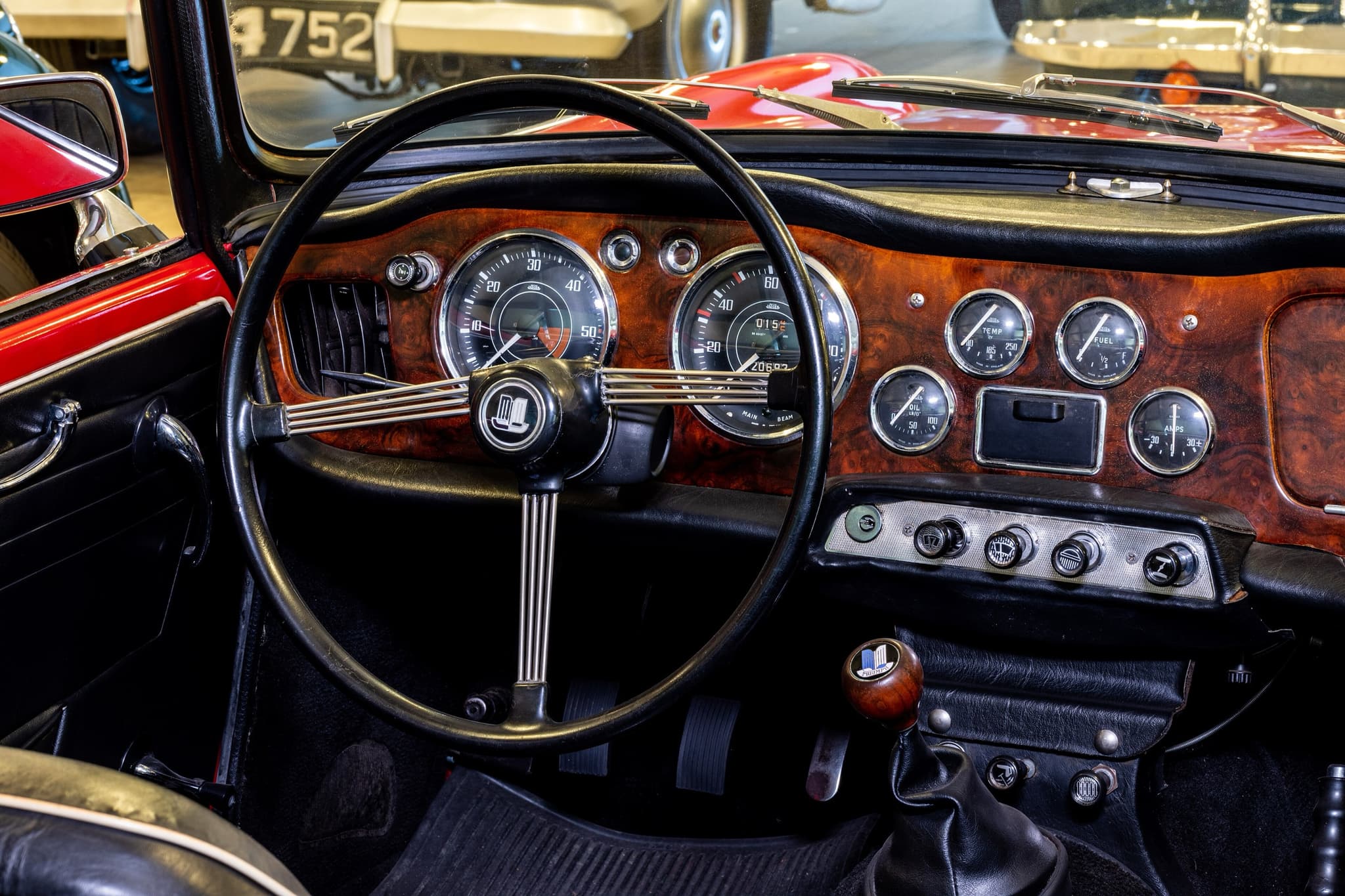
The instruments should be the originals: overhauling them is possible but costly, the German guide warned, and in 2009 it counted them among the parts no longer being made, with the wheels, the steering and the horn push with its built-in indicator switch, though supply changes. Carpets and trim were being reproduced, and the guide pointed buyers to the originality guides for the correct patterns. Even new, a TR4A could rattle: one owner wrote to Motor Sport in 1967 of scuttle shake and of trim screws that needed tightening.source 2source 9
Originality checklist
| Point | What is original | Source |
|---|---|---|
| Commission plate | CT on a TR4 or a live-axle TR4A, CTC on a TR4A IRS; L for left-hand drive, O for overdrive; the number matching the registration document | Vintage Triumph Register; TR Register |
| Dashboard | Painted on early TR4s, walnut on later TR4s and every TR4A; many early cars converted since | Vintage Triumph Register; insurer's guide |
| Carburettors | SU or Zenith-Stromberg, by date | Revington TR; Vintage Triumph Register |
| Wire wheels | 48 spokes on early cars, 60 on later ones, in several finishes | Vintage Triumph Register |
| Roof | The factory's two-piece hardtop; the Surrey top is its vinyl insert | Car and Driver, 1961 |
| Engine | The standard engine; the 2-litre one is rare, with the engine prefix CTA | Rimmer; Vintage Triumph Register |
| Body panels | Steel; glass-fibre panels are not original (the works rally cars had aluminium ones, and the Dové a glass-fibre roof) | German TR Register; Classic & Sports Car |
| Door mirrors | None from the factory on American TR4As; dealers fitted them | Vintage Triumph Register |
| Build record | A Heritage Certificate from the British Motor Museum | British Motor Museum |
Modifications and replicas
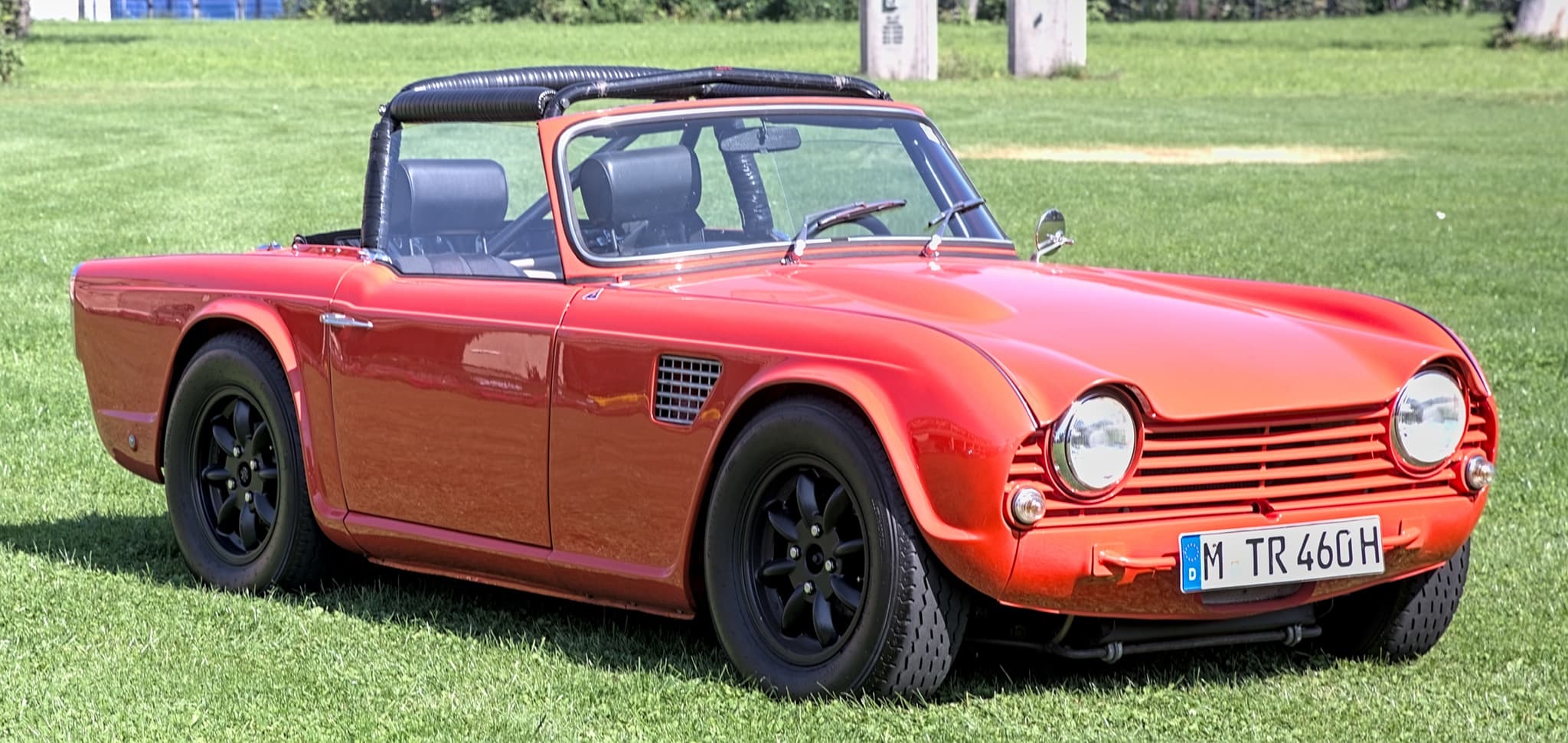
Tuning a TR4 was nothing new. In the 1960s the competition department of Standard-Triumph's American company offered tuning parts for the TR4 and TR4A, among them camshafts, an oversize-piston kit, Weber carburettors (promised for the TR4A in 1966), competition springs and anti-roll bars, and its owners' club newsletter announced a new camshaft in 1964. In the same issue a member advertised a Judson supercharger for the TR4. No source read covers six-cylinder or V8 conversions, so a car with one has to be judged on its own.
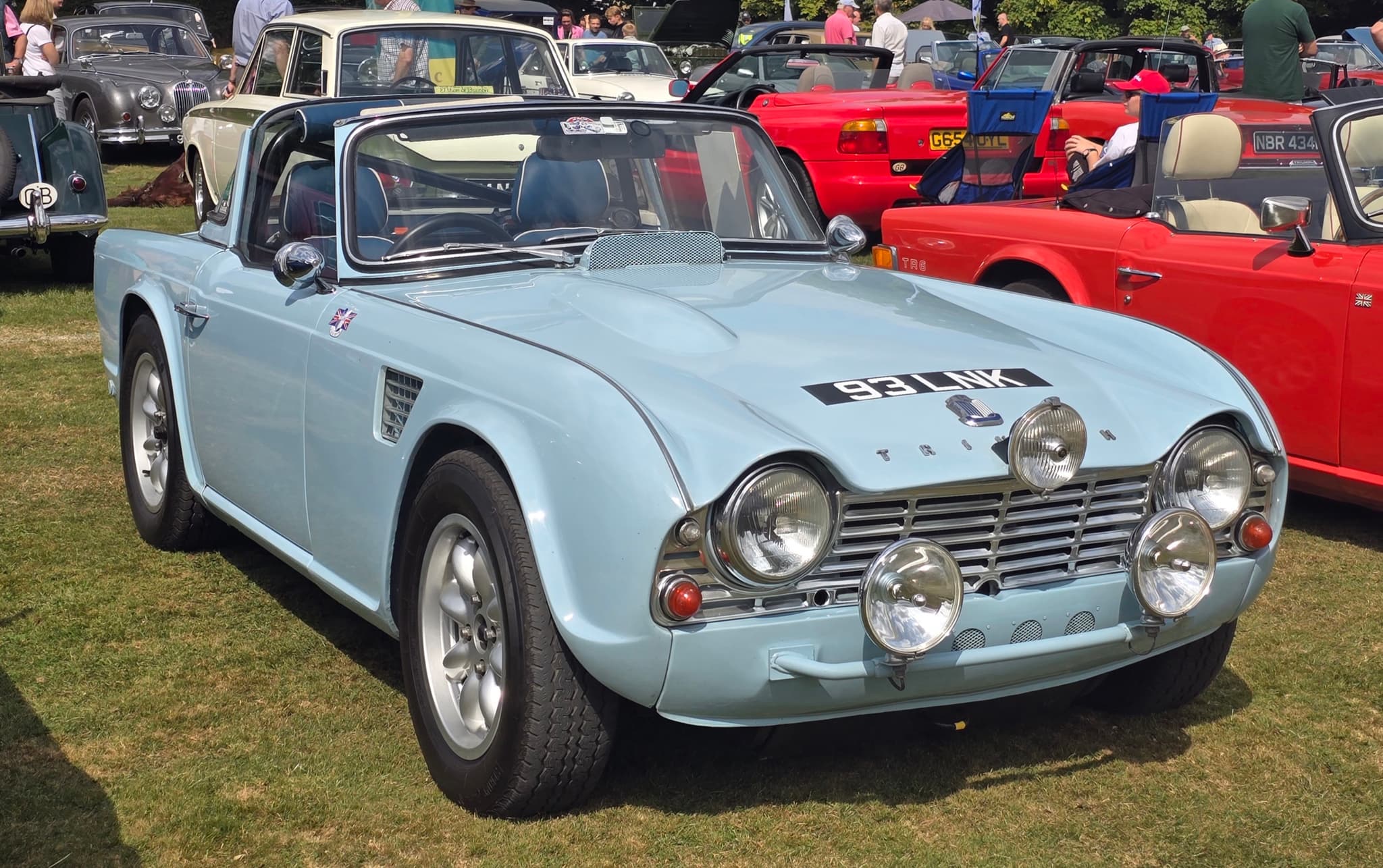
Copies of the works rally cars are built, and the body parts to make one are sold, so a works look settles nothing: notable TR4s explains how to tell the works cars from their copies.source 16source 17source 18source 19
Sources
Every source the site cites is on the sources page.
- Primarymade at the time, by the maker or by people who were there
- Referenceserious later work: clubs, specialists, magazines, books
- Goodwood Classic Solutions, "Buyer's guide: Triumph TR4", 1 Nov 2024, "rust is always going to be the deciding factor"; TR4 or TR4A; the live axle on left-hand-drive TR4As; US cars and the L suffix; the windscreen frame; panel gaps; leaks; "outriggers and rear suspension mounts can be vulnerable"; gearboxes "a little more fragile"; overdrive faults; converted dashboards. insurance.goodwood.com/buyers-guide/triumph-tr4-2 Reference
- Bruno Dwinger, "Geschichte, Typenkunde und Kaufberatung: Standard-Triumph TR4, TR5/TR250 – 'die Michelotti Autos'", TR-Register Deutschland, 2009, 13 pp. (PDF), Bruno Dwinger's guide, 2009, pp. 5–13; p. 5, a car already restored once; pp. 6, 9, the tools; p. 13, join a club; pp. 6–8: the shared shells; front, doors, sills, posts, floors, rear; accident damage; glass-fibre panels; pp. 8–9: the TR4 and TR4A frames, the rear crossmembers and plates, the horns, the wishbone brackets, the braces, the middle and the rear; p. 9: the differential studs, bushes, trunnions, ball joints, rack mounts; p. 11, the live axle; p. 12, wire wheels; pp. 10–11: noises and leaks; compression and the leak-down test; oil pressure; temperature and the thermostat; p. 11: the gearbox, overdrive, clutch and propshaft checks; p. 12, instruments and trim; p. 13, parts not remade in 2009; p. 6, glass-fibre panels. tr-register.de/wp-content/uploads/2025/08/Kaufberatung-TR4-und-TR5-und-TR250.pdf Reference
- TR Register, "Buyer Beware: TR6" (2 pp. PDF leaflet), p. 2, the checks common to every TR; p. 2, US cars and right-hand-drive conversions; p. 2, battery acid; the door posts; impact damage; p. 2, "the chassis used up to and including the TR4 were the strongest"; the front half and impact damage; p. 2, the registration document. tr-register.co.uk/storage/Pages/tr6-buyer-beware.pdf Reference
- Vintage Triumph Register, "TR4A" (history, change points and yearly output, buyer's and spotter's guides, numbering), the TR4A buyer's guide; the front wings' trailing ends; the rear arches; "The fore/aft strength of the car counts on solid sills"; the TR6 wishbone bracket; TR4A panels on a TR4 frame; the differential mounts; the universal joints and TR250 gaiters; the rear drums; oil pump and shells; the radiator shroud; liners and pistons in sizes; overdrive adjustment; the CTC prefix; carburettors; the CTA prefix; US mirrors. vintagetriumphregister.org/tr4a Reference
- Arthur Kelly, "Triumph Buyer's Guides" (general checklists), Vintage Triumph Register, Arthur Kelly's guide: join a club; "Marry in haste – repent at leisure"; compression, oil pressure and the coolant test. vintagetriumphregister.org/buyers-guides Reference
- Motor Sport, "The Triumph TR4: a rugged British sports car", with the data panel "The Triumph TR4 hard-top", Jan 1963, pp. 9–10, the leak at a window joint; the test car's oil pressure. motorsportmagazine.com/archive/article/january-1963/9/the-triumpth-tr4 Primary
- Aaron Severson, "Grandfather's Ax: The Many Evolutions of the Triumph TR4, Part 1: TR4 and TR4A", Ate Up With Motor, 22 Oct 2012, the splined half-shafts. ateupwithmotor.com/model-histories/triumph-tr4-tr4a/view-all Reference
- G. William Krause, The Illustrated History of Triumph Sports and Racing Cars, CarTech, 2017, p. 57, the splines. static.summitracing.com/global/images/technicalarticles/sad-ct596.pdf Reference
- Motor Sport, "Letters from Readers" (the TR4A letters), Feb 1967, p. 46, an owner's collapsed wire wheel; a new TR4A's trim screws. motorsportmagazine.com/archive/article/february-1967/46/letters-readers-february-1967 Primary
- Arthur Kelly (the VTR's TR4 consultant), "TR4": "A Historical Overview of the TR4" and the TR4 commission-number page, Vintage Triumph Register, liners changed without reboring; the commission plate; the dashboard; wire wheels. vintagetriumphregister.org/tr4 Reference
- Revington TR, "TR4: Technical Specification Change Points", the Stromberg change. revingtontr.com/the-tr-series/tr4/technical-specification-change-points Reference
- Dennis May, "Technical Report" on the TR-4 (cover story), Car and Driver, Oct 1961, pp. 19–23, the hardtop and the insert. Primary
- Graham Robson (essay "15 Years of Evolution"), Triumph TR2 – TR3/3A, TR4/4A – TR5, TR250 1953–1968 Parts & Accessories Catalogue, Rimmer Bros, edn 2.1 (source code TR2512), Part 1, p. 5, the 2-litre engine rare. rimmerbros.com/images/PDFs/TR2-5_Part1.pdf Reference
- Julian Balme, "TR4: Triumph's rally underdog", Classic & Sports Car, 4 Aug 2021, the works cars' aluminium panels. classicandsportscar.com/features/tr4-triumphs-rally-underdog Reference
- British Motor Museum (BMIHT), "Heritage Certificates", the Heritage Certificate. britishmotormuseum.co.uk/archive/heritage-certificates Primary
- Triumph Sports Owners Association, Triumph Sports Owners Association Newsletter, February 1963, Feb 1963 (vol. 9 no. 2), Kastner's Sebring memo: the "D" camshaft, competition springs, the anti-roll bar. vintagetriumphregister.org/tsoa/TSOA0263.pdf Primary
- Triumph Sports Owners Association, Triumph Sports Owners Association Newsletter, June 1964, Jun 1964, competition parts; the Judson supercharger advertised. vintagetriumphregister.org/tsoa/TSOA0664.pdf Primary
- Road & Track, "Multi-Purpose Triumph", Dec 1966, pp. 92–94, the 87 mm bore kit and heavy-duty springs through the competition department; Webers "soon to be available for the TR-4A". kaskastner.com/roadtrack2.pdf Primary
- Revington TR, Replica works rally TR4 body parts, replica works rally body parts. revingtontr.com Reference