Triumph TR4 Images
The TR4, the TR4A and the Dové GTR4 in pictures: the cars, their hardtops and Surrey tops, dashboards and engines, colours as they look today, and a rally TR4 photographed in 1964.
Giovanni Michelotti's body changed little between the first TR4 of 1961 and the last TR4A of 1967, so what separates the cars in a photograph is detail: the grille and its lamps, the badges, the strip along the side, the dashboard. The pictures are grouped by what they show, from the cars themselves to their roofs, cockpits and engines, their colours and a few in competition, and each opens a larger view.
A caption's date is the photograph's, and where the version rests on what the photographer said, the caption says so. Some cars carry later parts, which the captions name where they show.source 1source 2
Three cars, one body
The TR4 and the TR4A are told apart most easily from the front, as identification explains, and each caption below says which car it shows. Early and late TR4s differ in smaller things, among them the longer bulge that the bonnet (hood) gained in 1962, and the dashboard, which Interiors describes. None of the three TR4s below shows enough to say whether it is early or late; the painted dashboard under Interiors belongs to an early car.
A TR4A's rear suspension shows only from behind: a car with independent suspension has an IRS badge beside its TR4A badge on the boot (trunk), like the car in Michigan, and a live-axle car, built for North America only, has none. The TR4A page has a film of one on the road.
The Dové GTR4 began as a TR4, or now and then a TR4A, and kept its front; Thomas Harrington Ltd of Hove gave it, for L. F. Dove of Wimbledon, a fixed roof and tail of glass fibre. In a photograph the fastback roof line and the small script badge set it apart.source 3source 2source 4source 5source 6source 7source 1
TR4 3
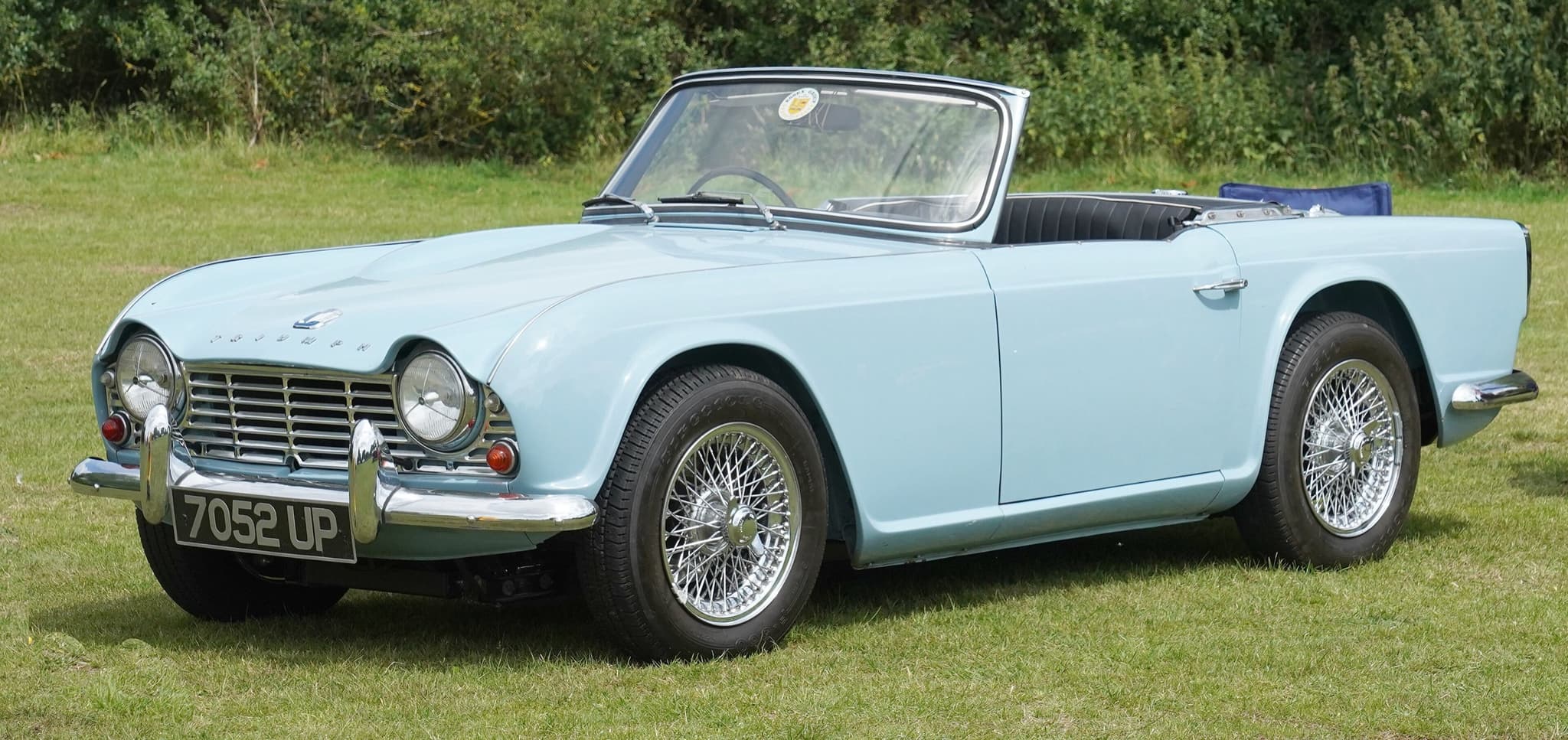
1 Little Waltham, Essex, June 2026: a pale blue TR4 on wire wheels, parked on a mown lawn before a hedge with its hood (soft top) stowed.
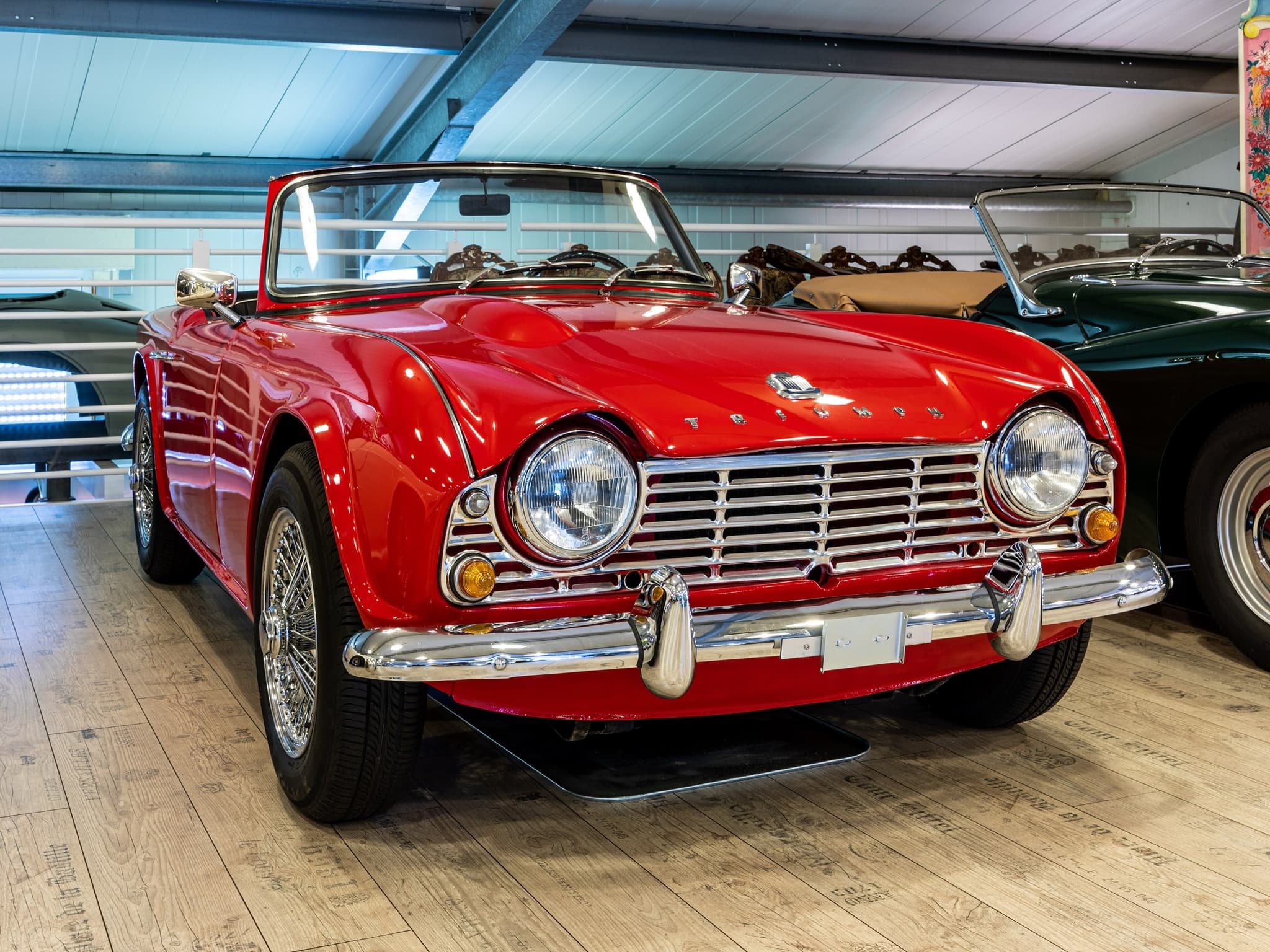
2 Nottuln, Germany, August 2021: a red TR4 on display in the town's Oldtimermuseum, its hood down.
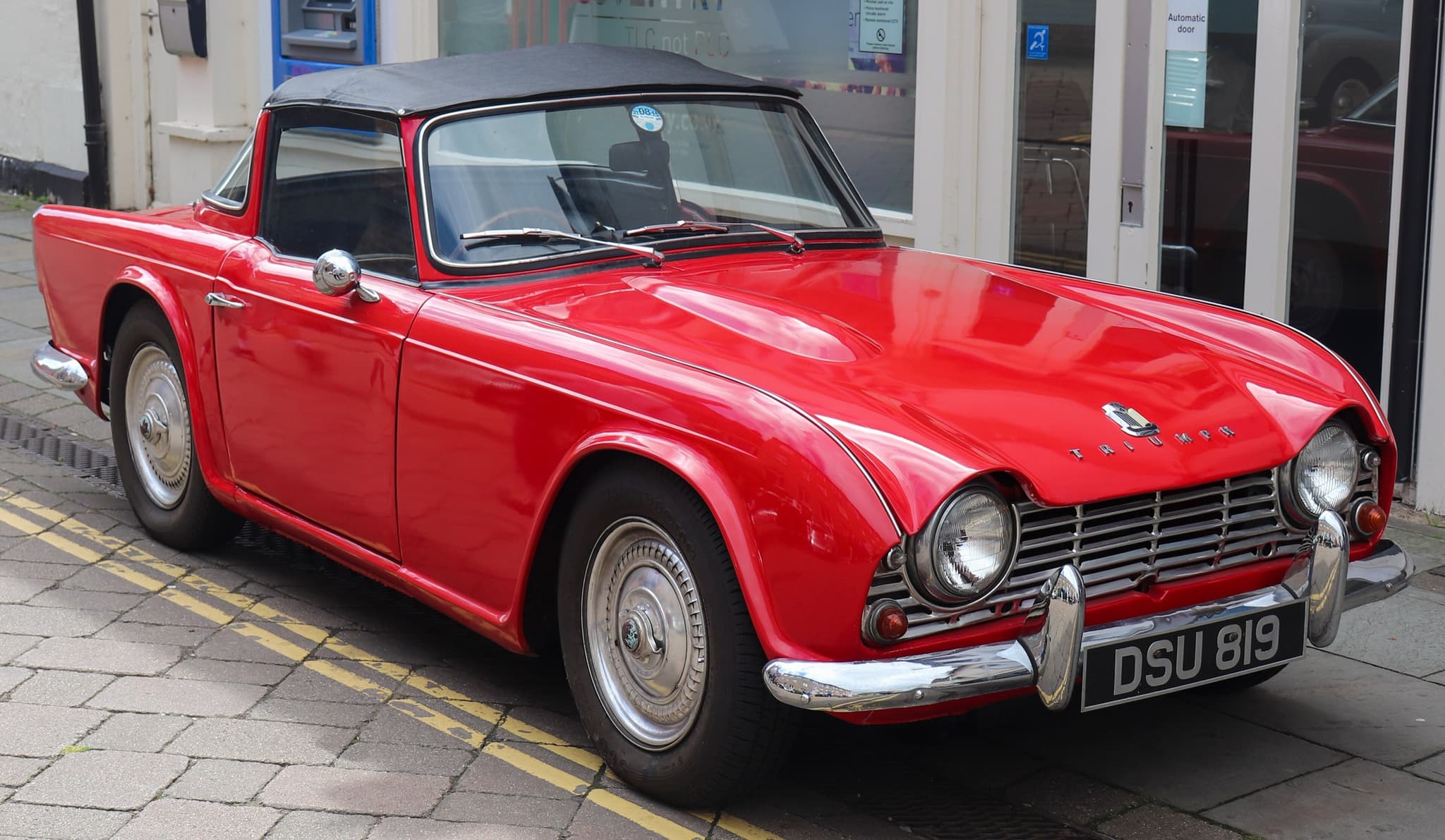
3 Warwick Classic Car Show, August 2019: a red TR4 on disc wheels at the kerb on double yellow lines, its black hood raised.
TR4A 3
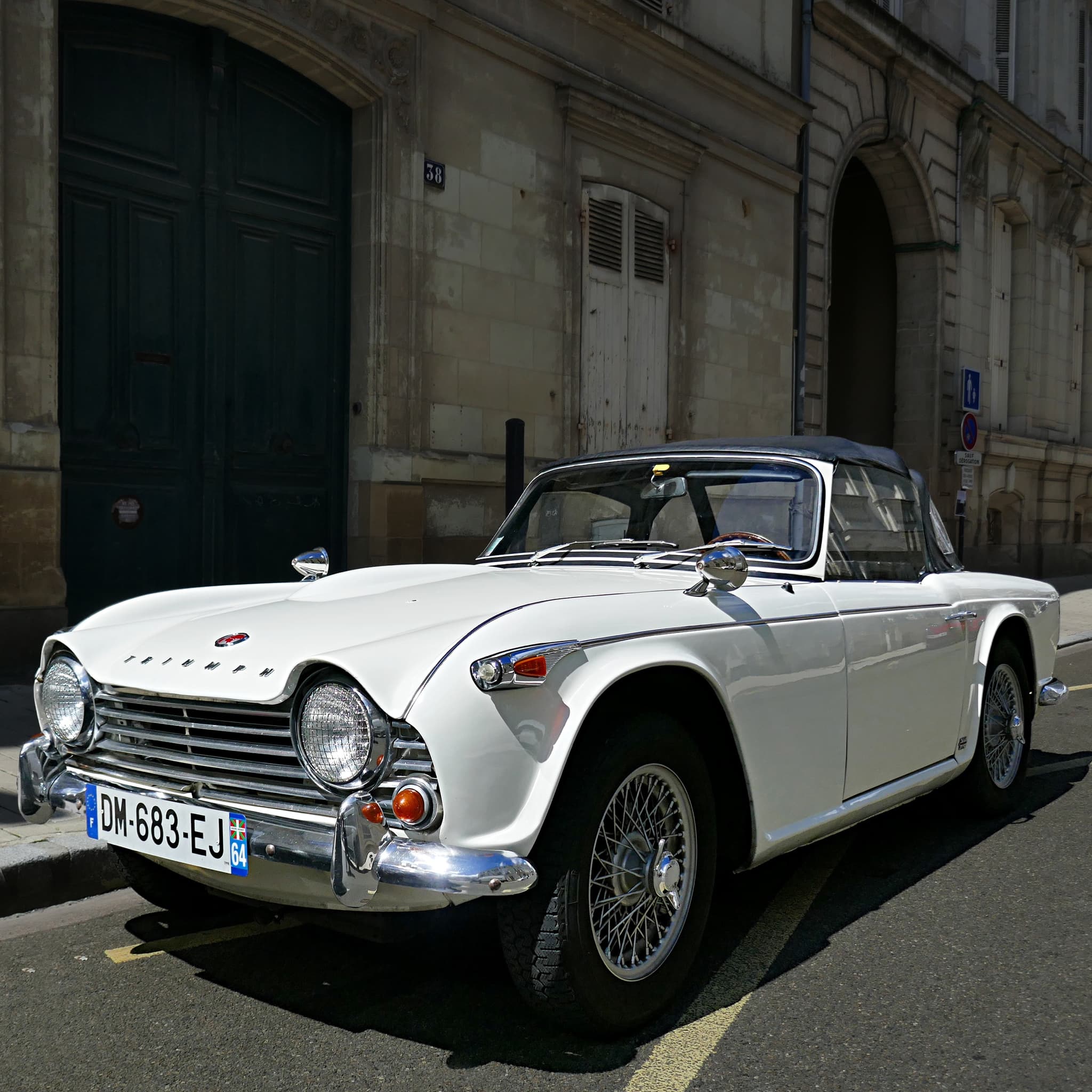
4 Angers, France, June 2021: a white TR4A with its hood up, outside a limestone town house.
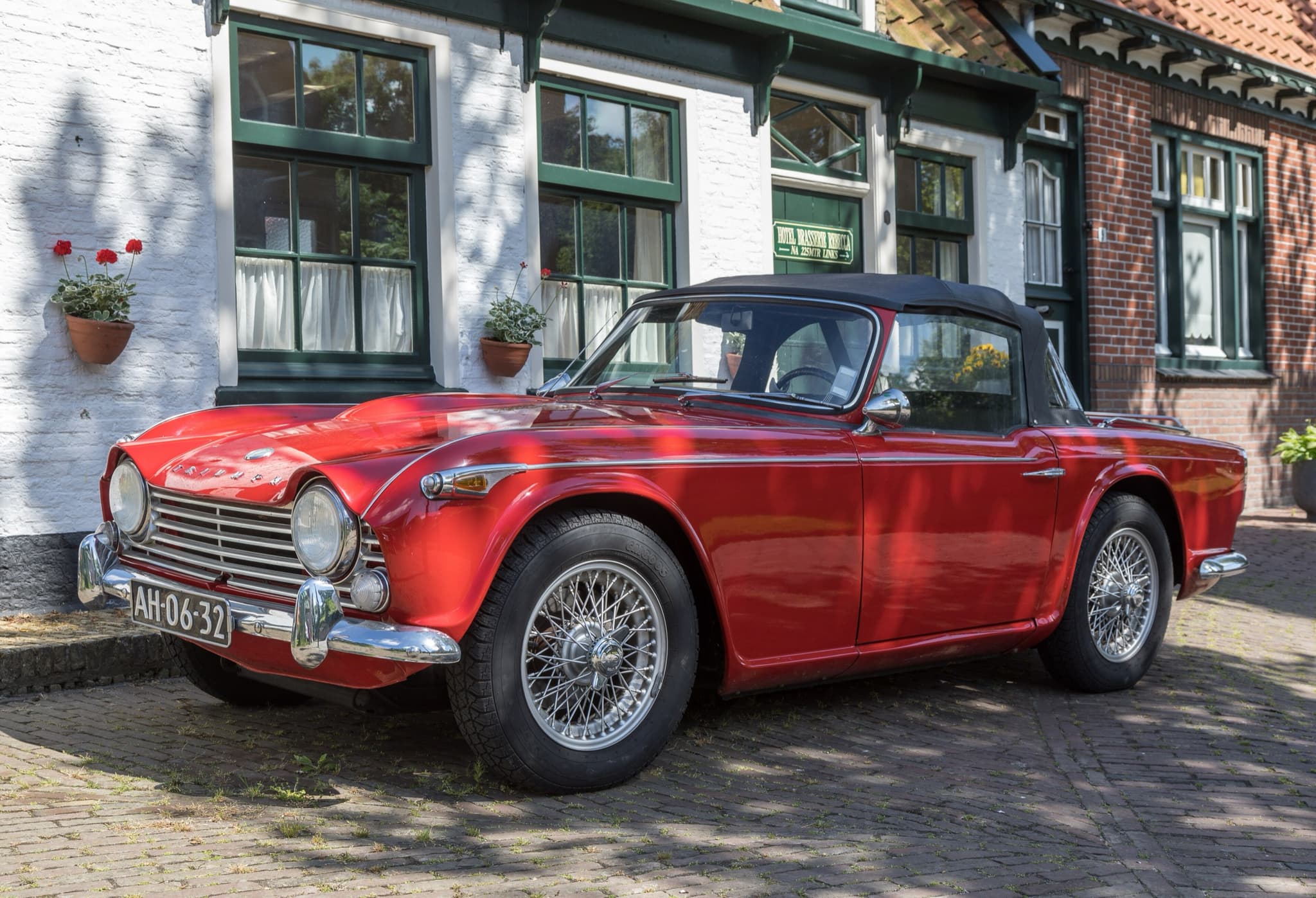
5 Texel, the Netherlands, June 2017: a red TR4A with a luggage rack at the back, outside a whitewashed house.
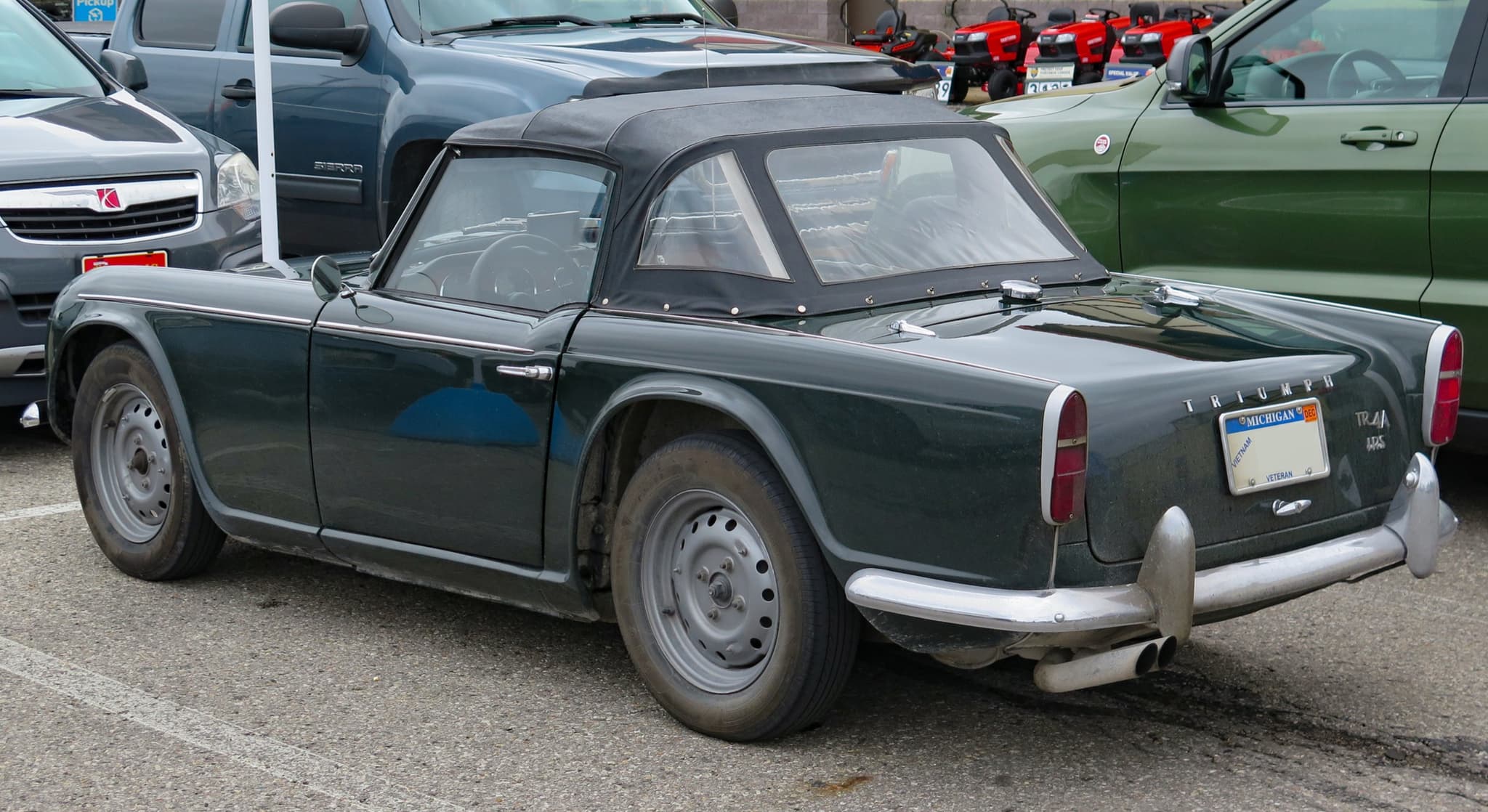
6 Gaylord, Michigan, August 2023: the TR4A and IRS badges at the back of a dark green TR4A IRS, whose twin exhaust tips are not original.
Dové GTR4 2
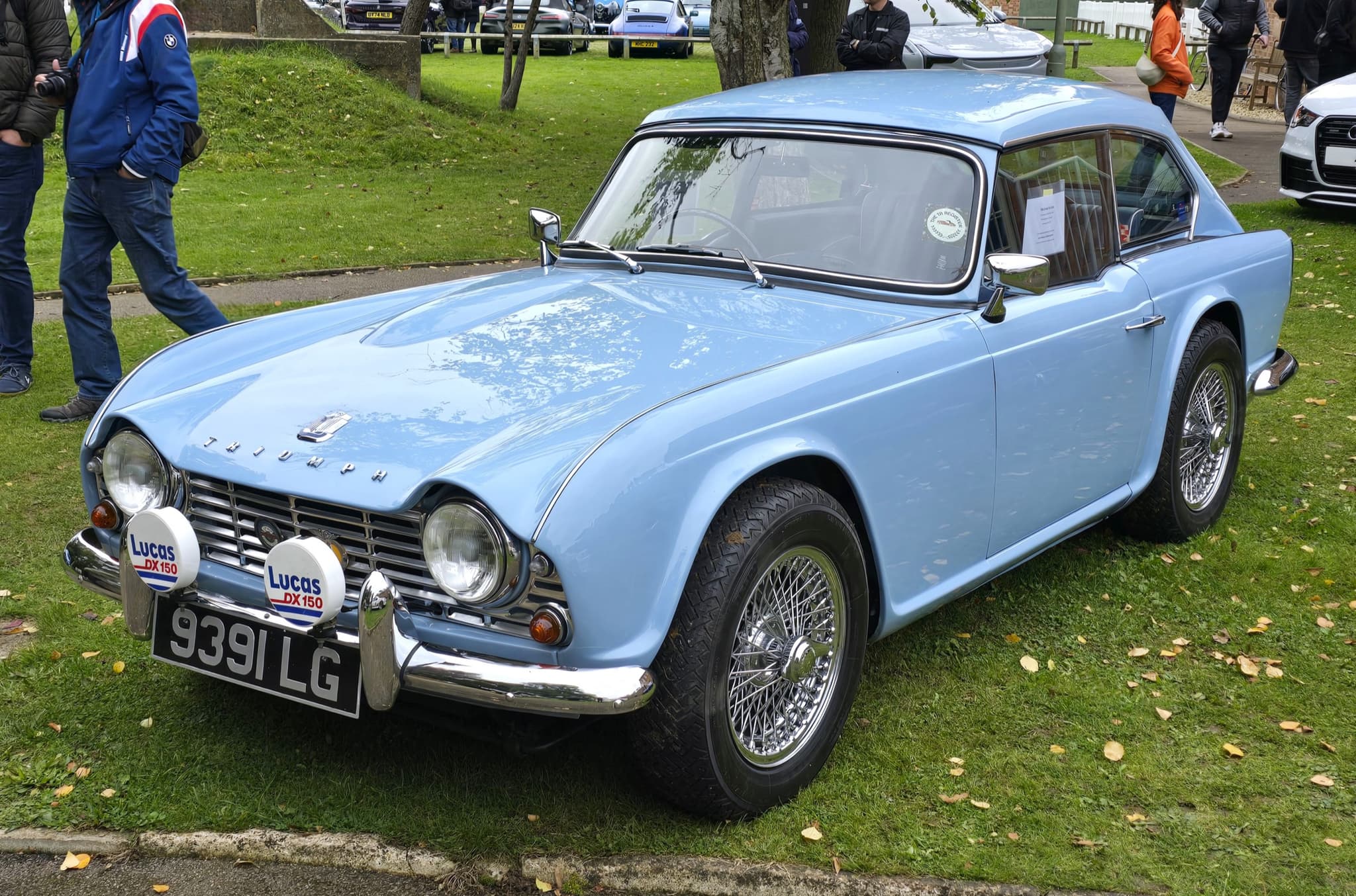
7 Bicester Heritage Scramble, Oxfordshire, October 2024: a pale blue Dové GTR4, its fixed fastback roof running down to the tail.
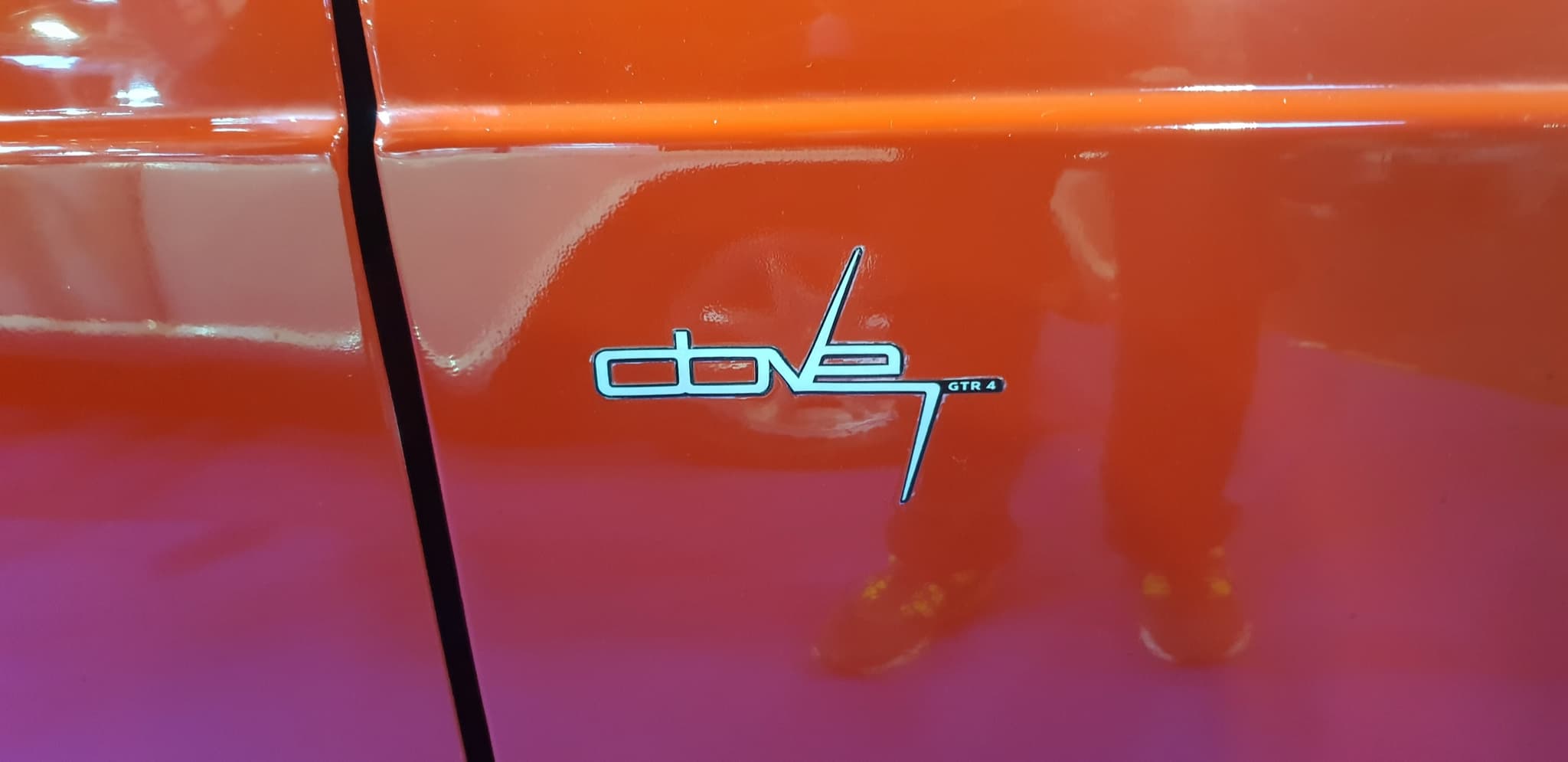
8 Classic Motor Show, NEC Birmingham, November 2025: the chrome script on an orange Dové GTR4, spelt dove without an accent, with a GTR4 tag.
Picture credits (8)
- 1 kitmasterbloke, CC BY 4.0
- 2 Dietmar Rabich, CC BY-SA 4.0
- 3 Vauxford, CC BY-SA 4.0
- 4 Pom', CC BY-SA 2.0
- 5 Joachim Kohler, CC BY-SA 4.0
- 6 Elise240SX, CC BY-SA 4.0
- 7 MrWalkr, CC BY-SA 4.0
- 8 Andrew Bone, CC BY 4.0
Roofs: the hardtop and its insert
Below, two cars have only the hardtop's rear section in place, the roof open above the seats, and a third, at Lytham Hall, has the factory's vinyl Surrey top clamped between that section and the windscreen (windshield). The Surrey top page explains the parts of the roof and the confusion over the name.source 8source 9source 3
Panel out, Surrey top on 3
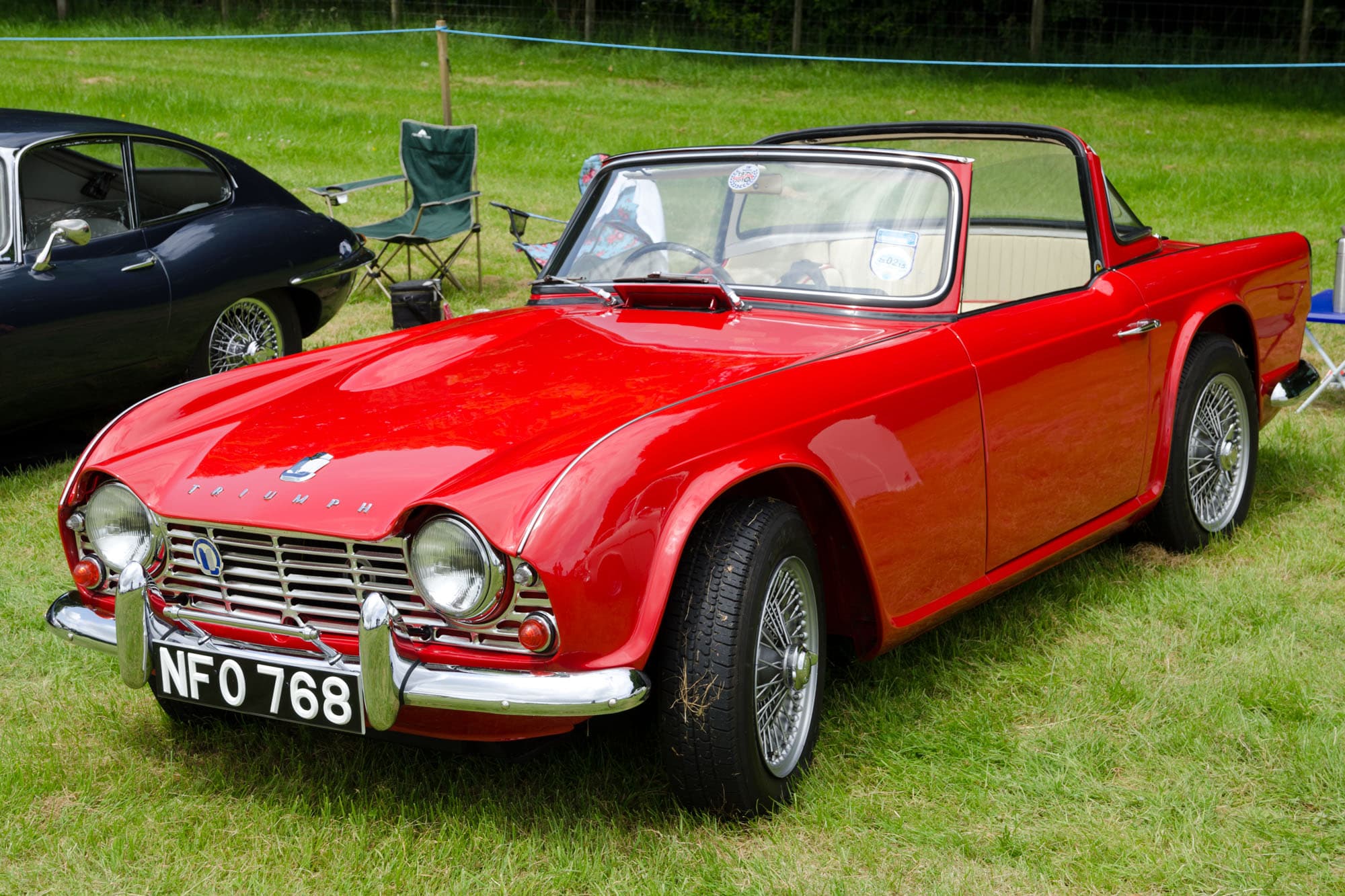
9 Hoghton Tower, Lancashire, June 2014: a red TR4 open to the sky, with only the rear section of its hardtop in place.
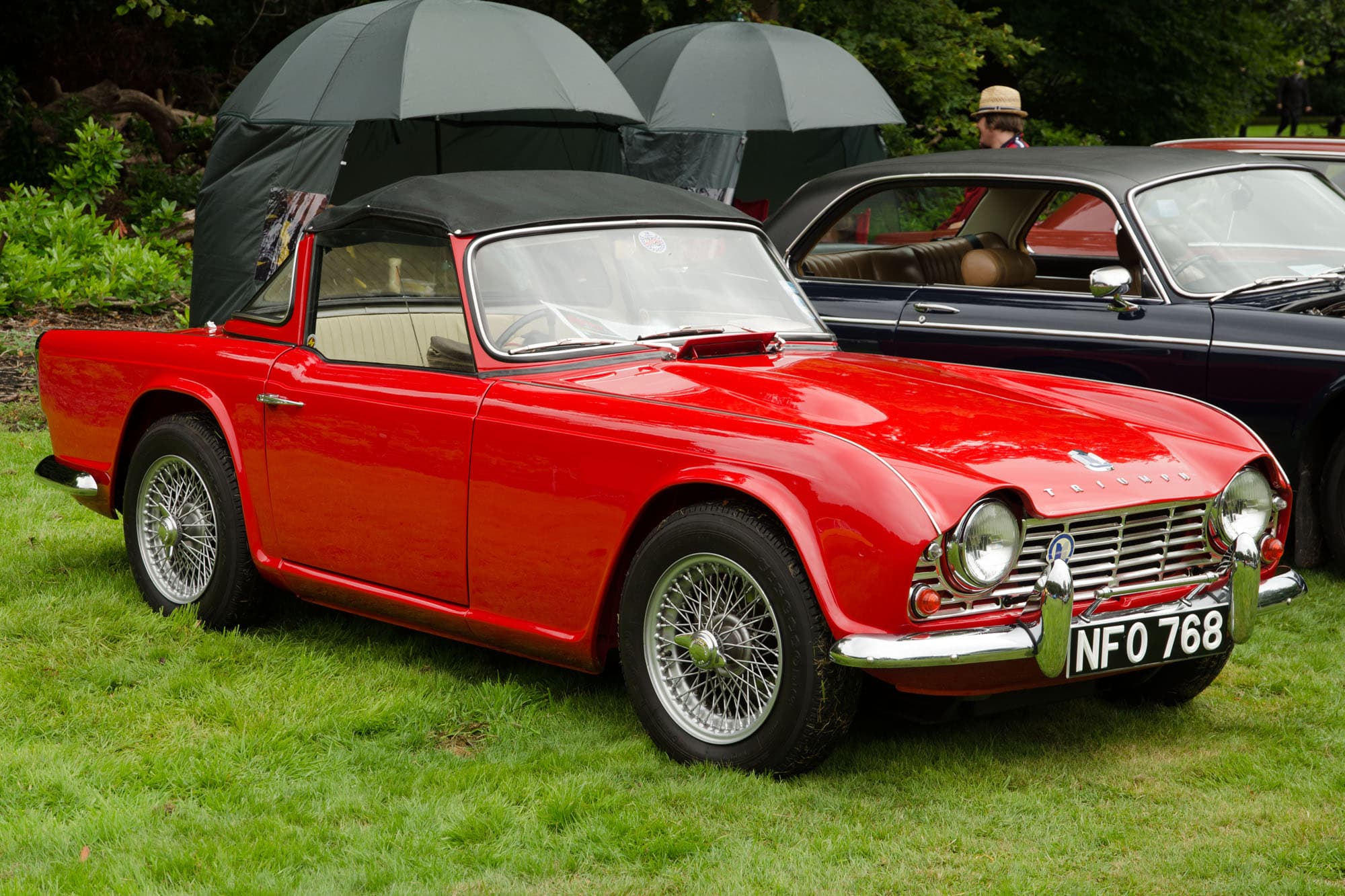
10 Lytham Hall, Lancashire, August 2014: a red TR4 on wire wheels on the grass, the black vinyl insert closing the gap over its seats.
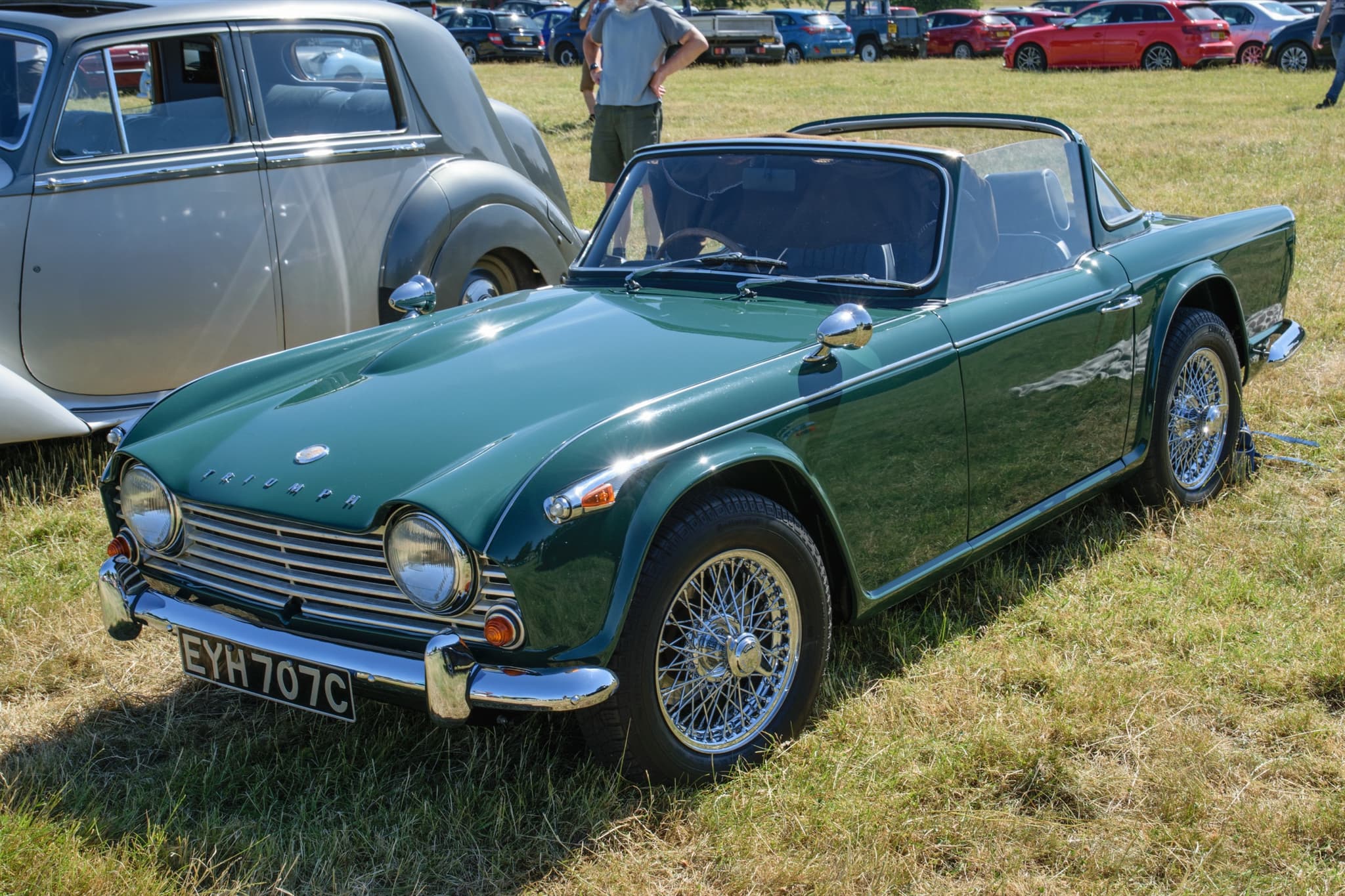
11 Leighton Hall Classic Car Show, Lancashire, July 2018: a dark green TR4A with its hardtop's rear section fitted and nothing over the seats.
Picture credits (3)
- 9 SG2012, CC BY 2.0
- 10 SG2012, CC BY 2.0
- 11 Steve Glover, CC BY 2.0
Interiors
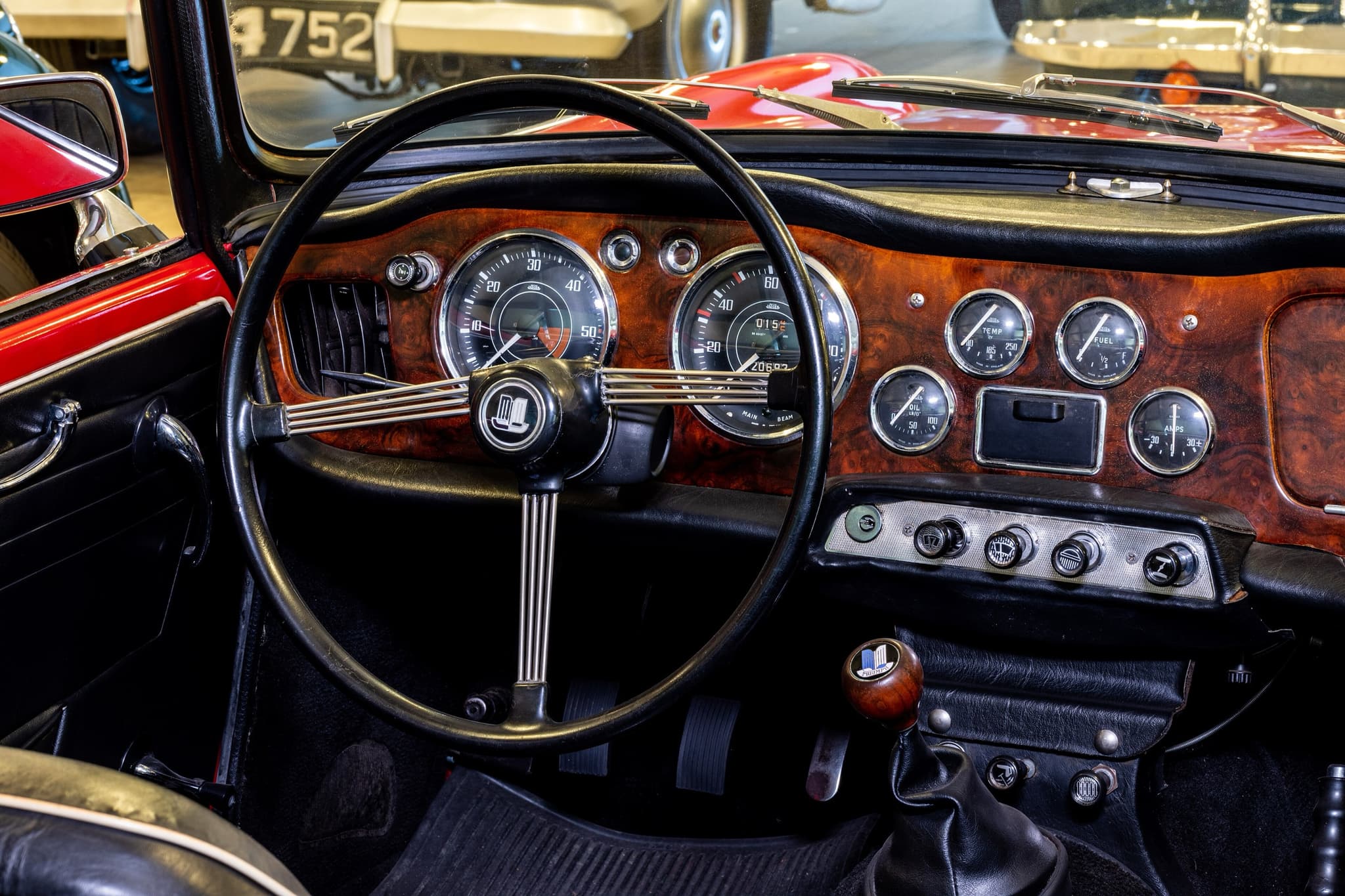
A painted dashboard came first, on the early TR4s, and walnut became common later, standard on the TR4A; many early cars have had walnut fitted since, and the identification page explains what that means for dating a car. Both cockpits here have later steering wheels, as their captions say.source 10source 11source 2
Painted and walnut 2
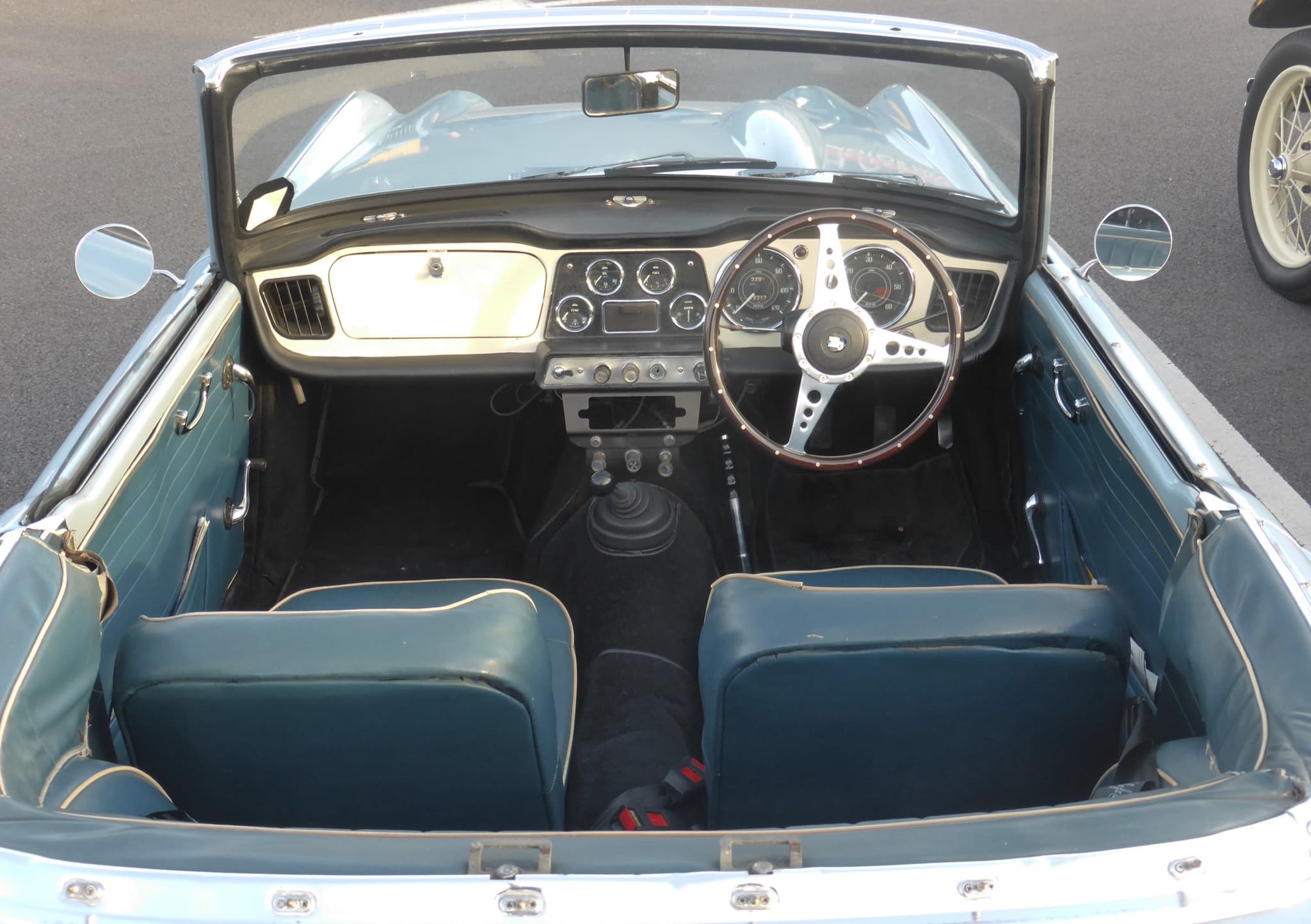
12 Sparkford, Somerset, October 2018: an early TR4's dashboard, painted ivory, with blue seats and a later wood-rim wheel.
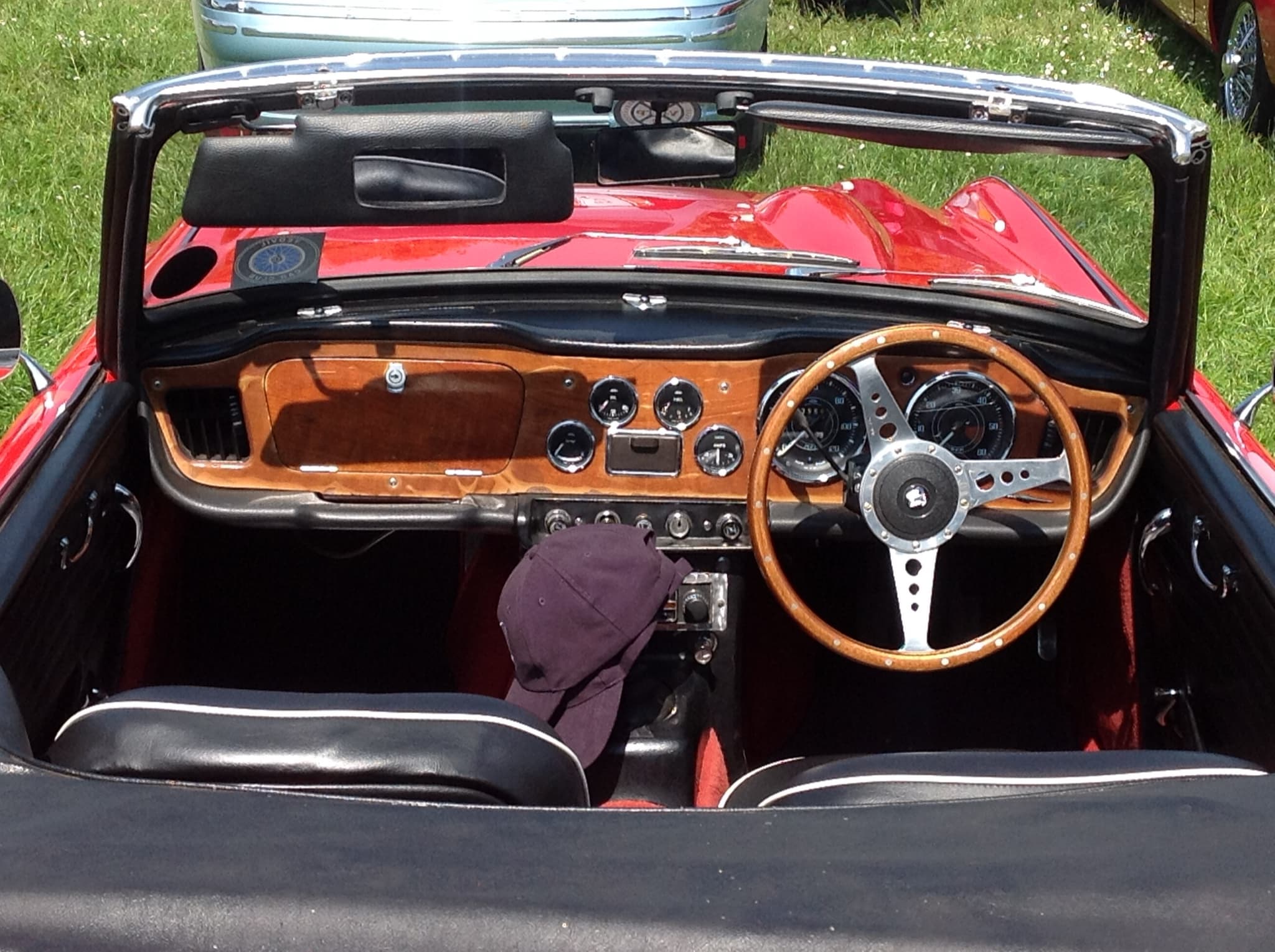
13 Dorset, May 2016: looking over a folded hood at a walnut dashboard, a centre console and a radio in a right-hand-drive car with an aftermarket wood-rim wheel.
Picture credits (2)
- 12 Andrew Bone, CC BY 2.0
- 13 Andrew Bone, CC BY 2.0
Engine bays
One engine served all three cars: a four-cylinder with wet liners, the same in the Dové as in the TR4 and TR4A. SU carburettors came first, Zenith-Strombergs took over on the TR4 during 1963, and TR4As were built with both. A picture of the engine alone cannot tell a TR4 from a TR4A, so the captions give each version as its photographer did.source 8source 12source 7source 6source 13
Under the bonnet 3
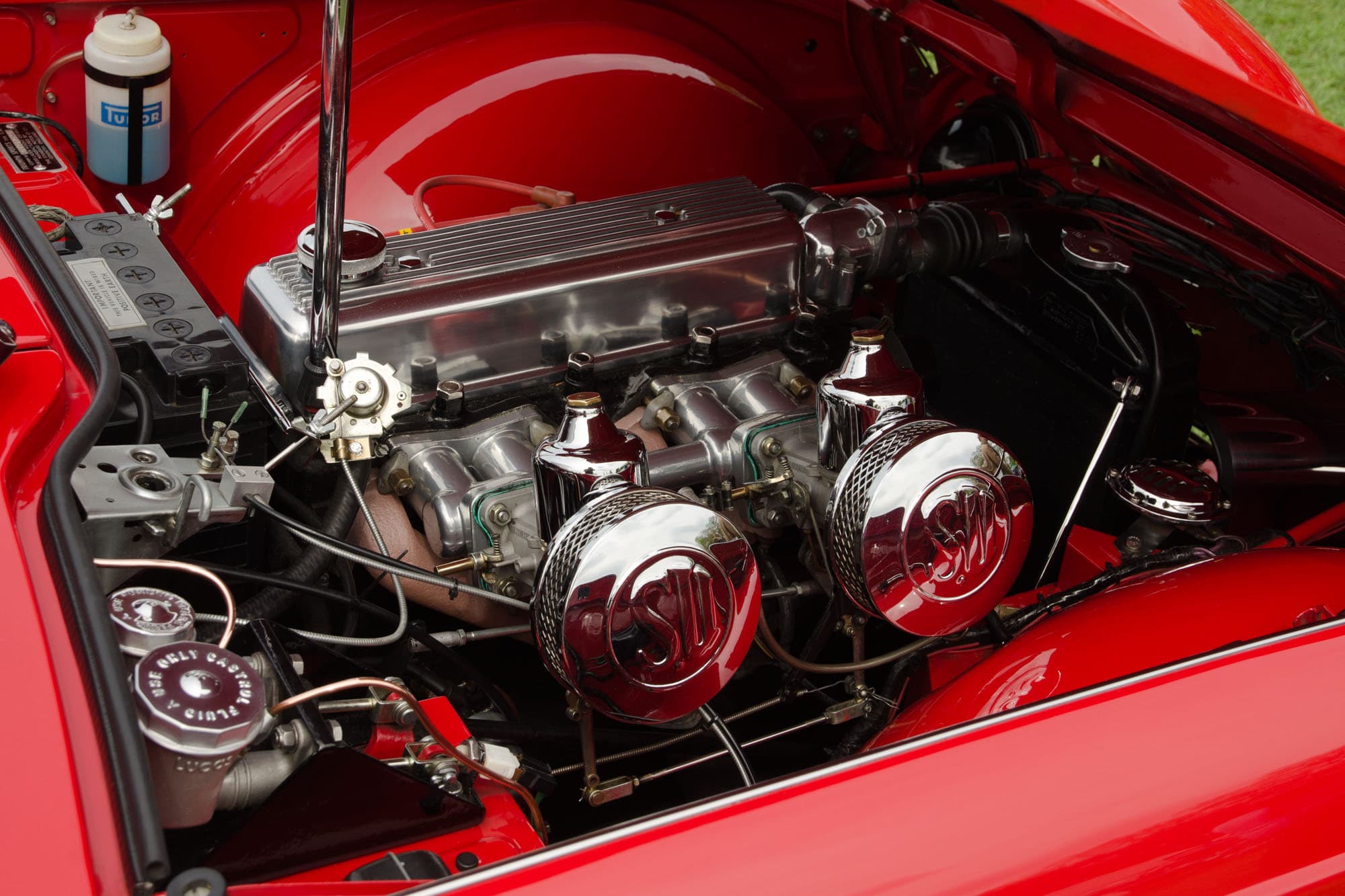
14 Catton Hall Classic Car Show, Derbyshire, May 2014: twin SUs seen from above in a red car its photographer calls a TR4, their chrome filter covers and the polished rocker cover later additions.
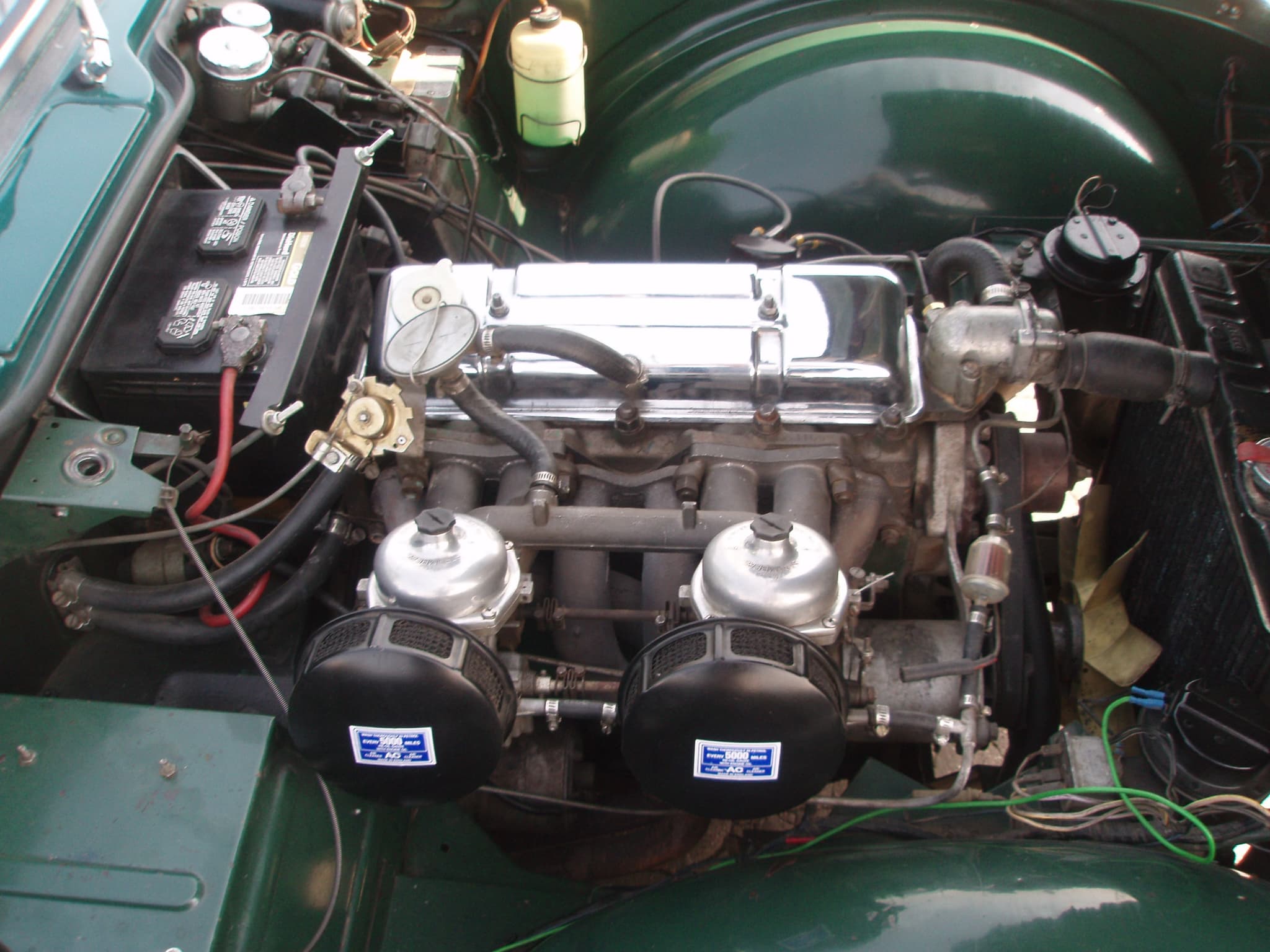
15 Photographed in June 2012: round air cleaners on twin Zenith-Strombergs, in a green car its photographer describes as a late TR4 built for the United States.
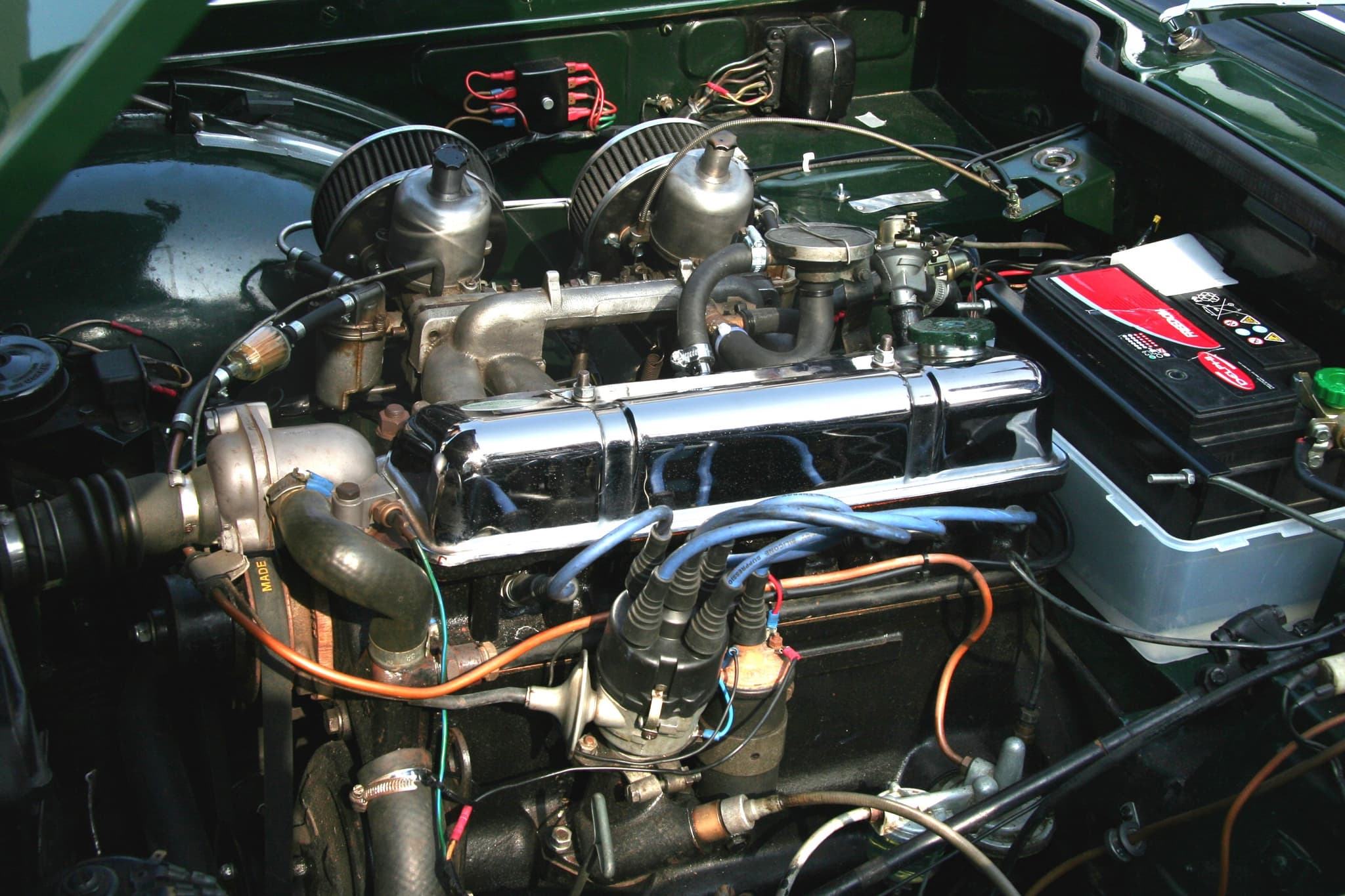
16 Mülheim-Kärlich, Germany, May 2009: twin SUs, with pancake air filters among other later parts, on an engine its photographer gives as a TR4A's.
Picture credits (3)
- 14 SG2012, CC BY 2.0
- 15 Akela NDE, CC BY-SA 2.0 fr
- 16 Lothar Spurzem, CC BY-SA 2.0 de
Colours
When the TR4 reached America in 1961 the importer offered it in six colours. A photograph is a poor guide to any of them: light, cameras and repainting all change a colour, so the captions give each car's colour as it looks in the picture, and the specifications give what is known of the factory's colours and trim.source 14source 10
As they look today 4
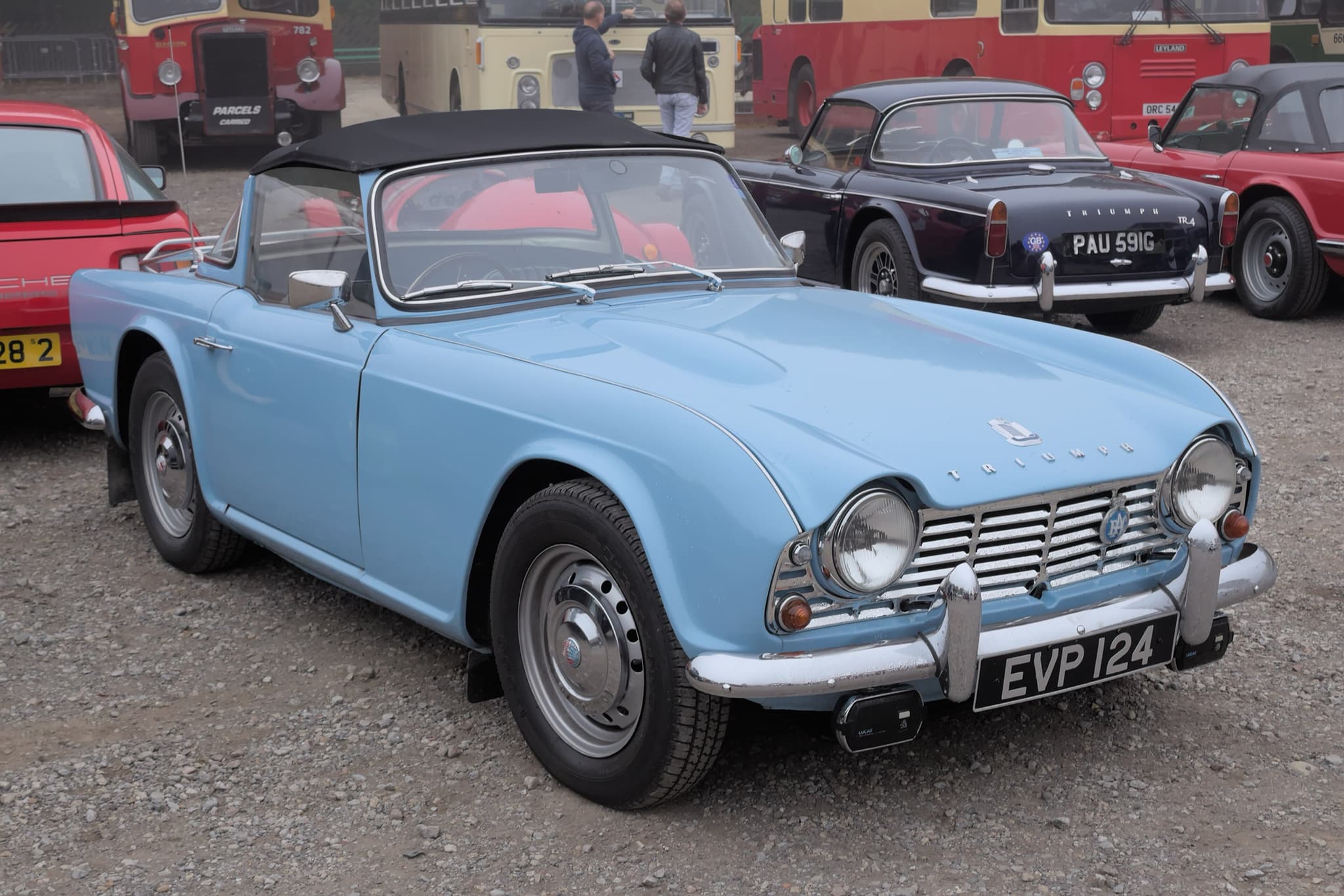
17 Ruddington, Nottinghamshire, October 2025: a pale blue TR4 with its black hood up and plain steel wheels, among the buses of the Autumn Transport Rally.
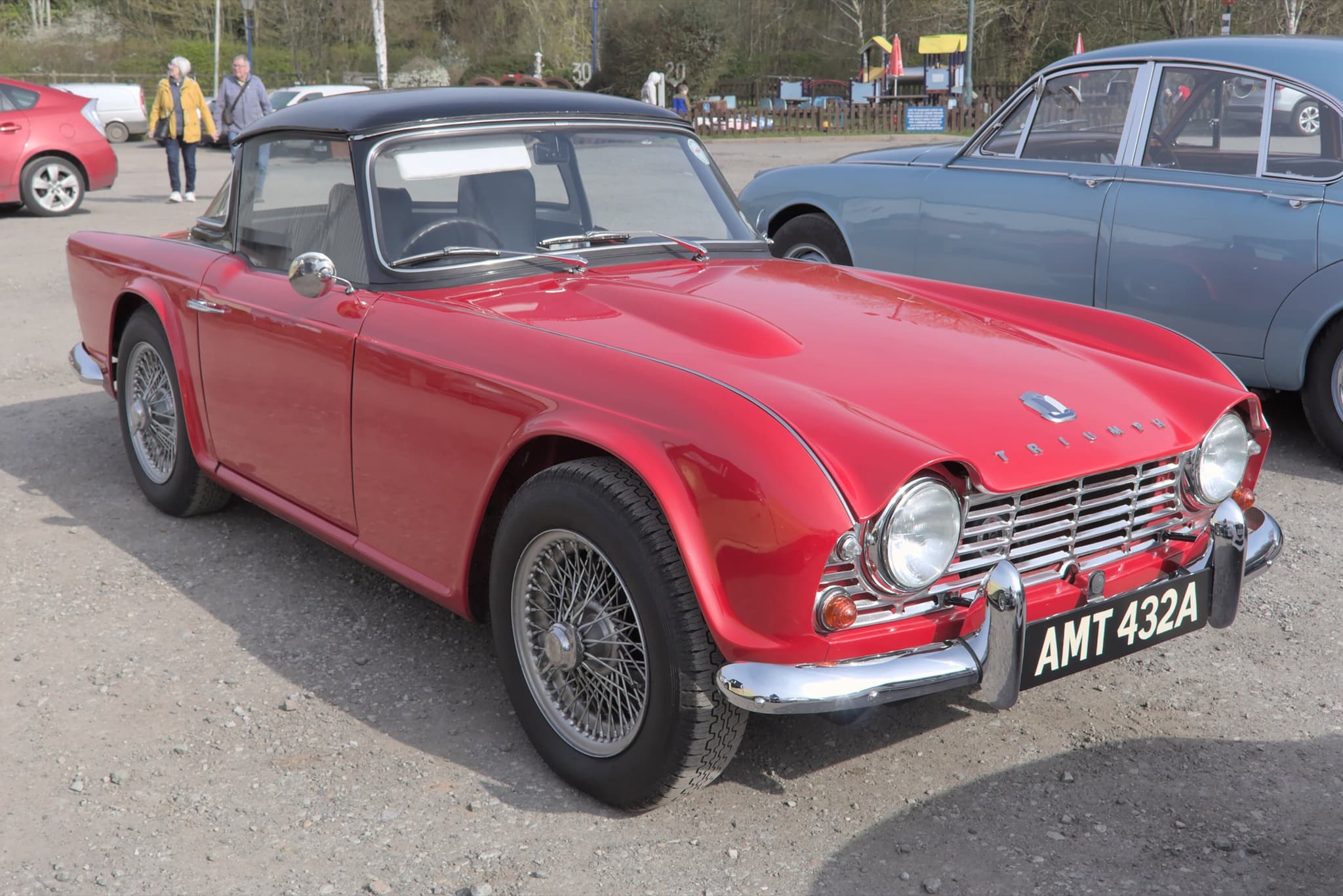
18 Spring Transport Gala, Ruddington, March 2026: a red TR4 on wire wheels, with a black hardtop.
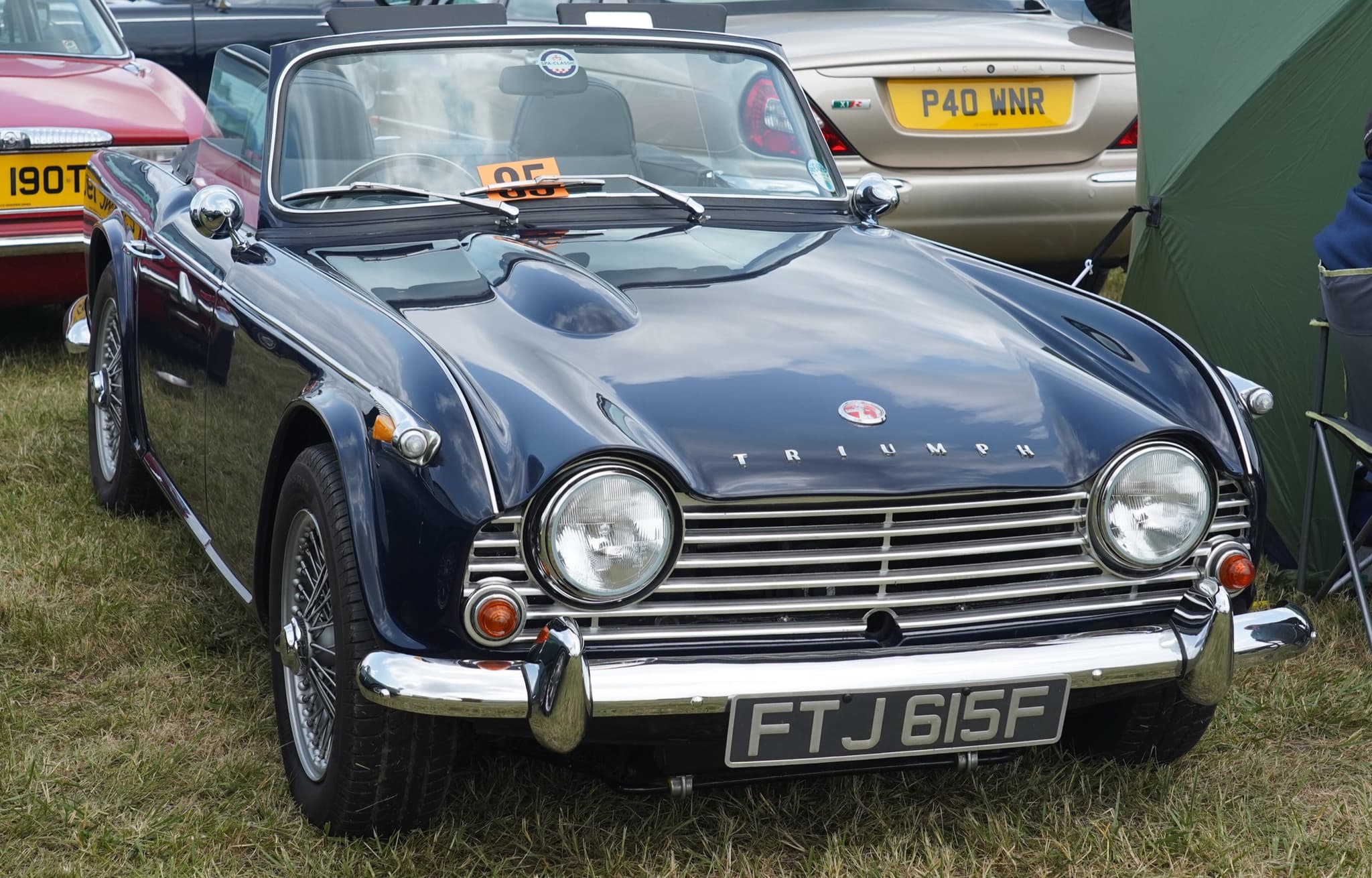
19 Marks Tey, Essex, June 2025: a dark blue TR4A, hood down, between a red car and a gold Jaguar on the field of the Aldham Old Time Rally.
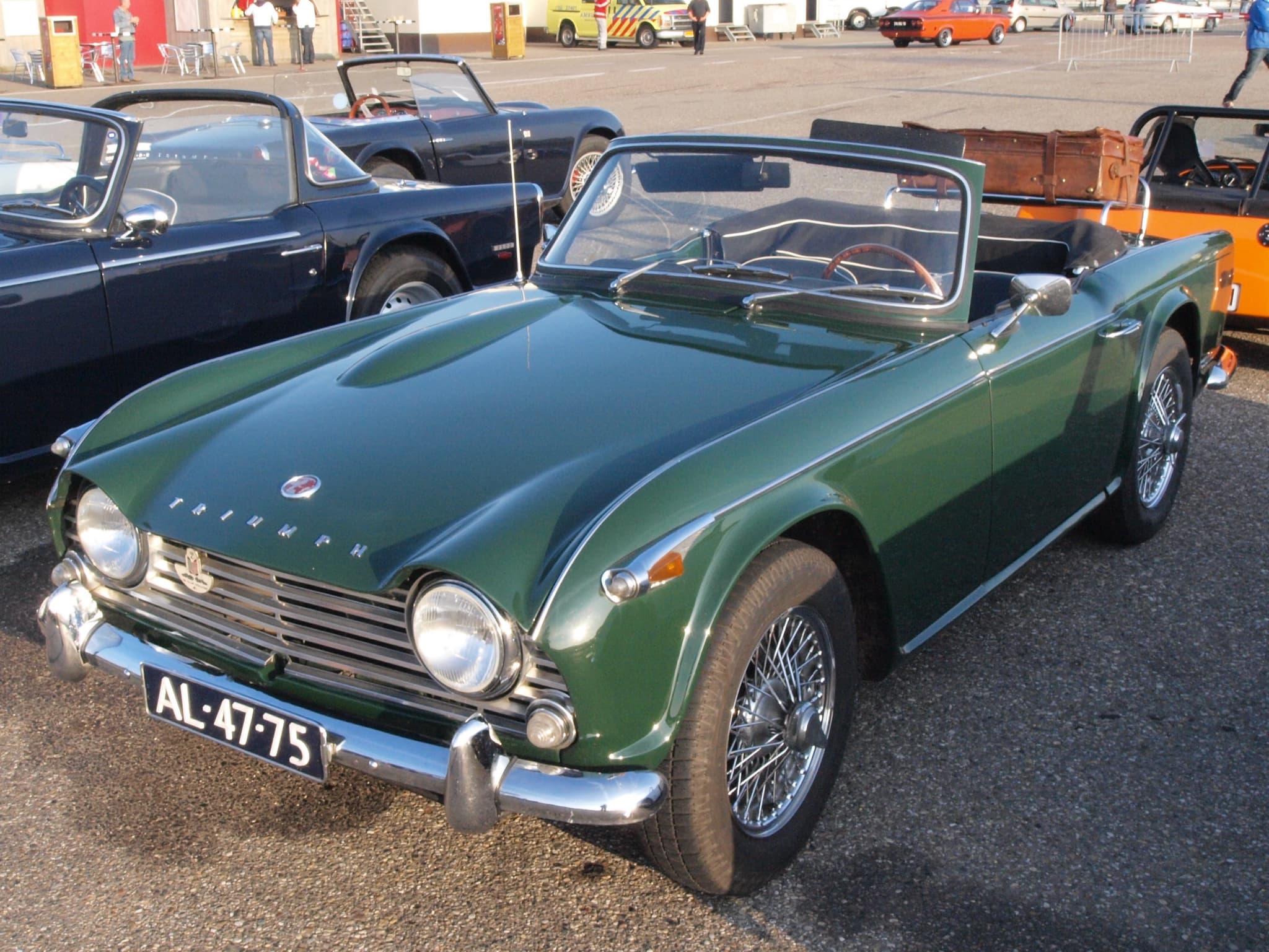
20 Zandvoort, the Netherlands, September 2009: a dark green TR4A, hood down, with a club badge on its grille.
Picture credits (4)
- 17 Aethonatic, CC0
- 18 Aethonatic, CC0
- 19 kitmasterbloke, CC BY 2.0
- 20 Alf van Beem, CC0
Racing and rallying
Only one picture here was taken while the TR4 was being built: an Anefo press photograph from Zandvoort, during the Tulip Rally of April 1964, of a TR4 entered by a private British crew after the works team had stopped rallying TR4s in Europe. The other two are recent, a hardtop wearing one of the works team's registrations and a TR4 racing on the Nürburgring. Racing tells the story of the works team's cars and the Sebring cars.source 15source 16
In competition 3
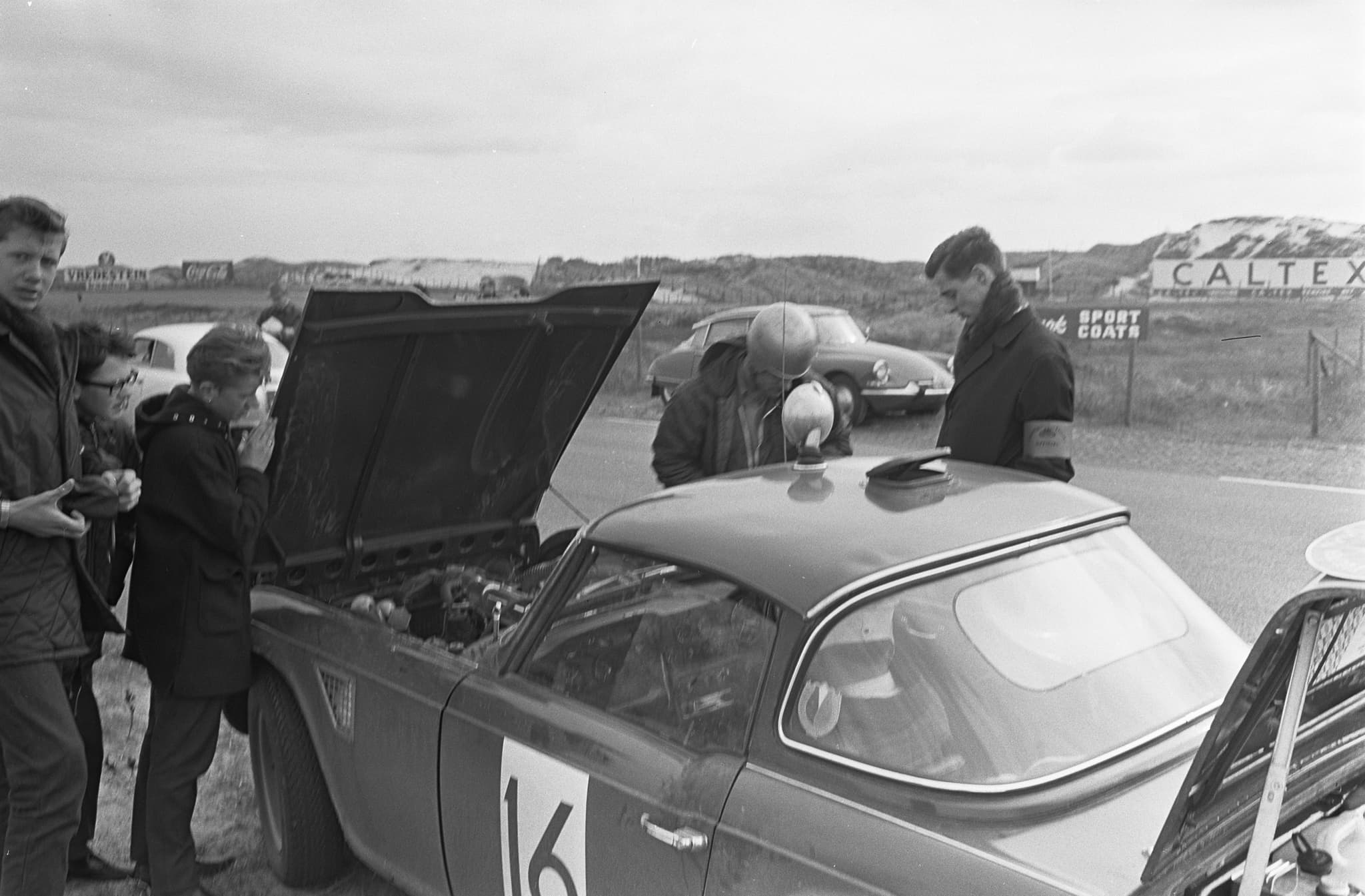
21 Zandvoort, 23 April 1964: onlookers and an official at the raised bonnet of TR4 No. 16, a private hardtop in the 16th Tulip Rally (Anefo press photograph).
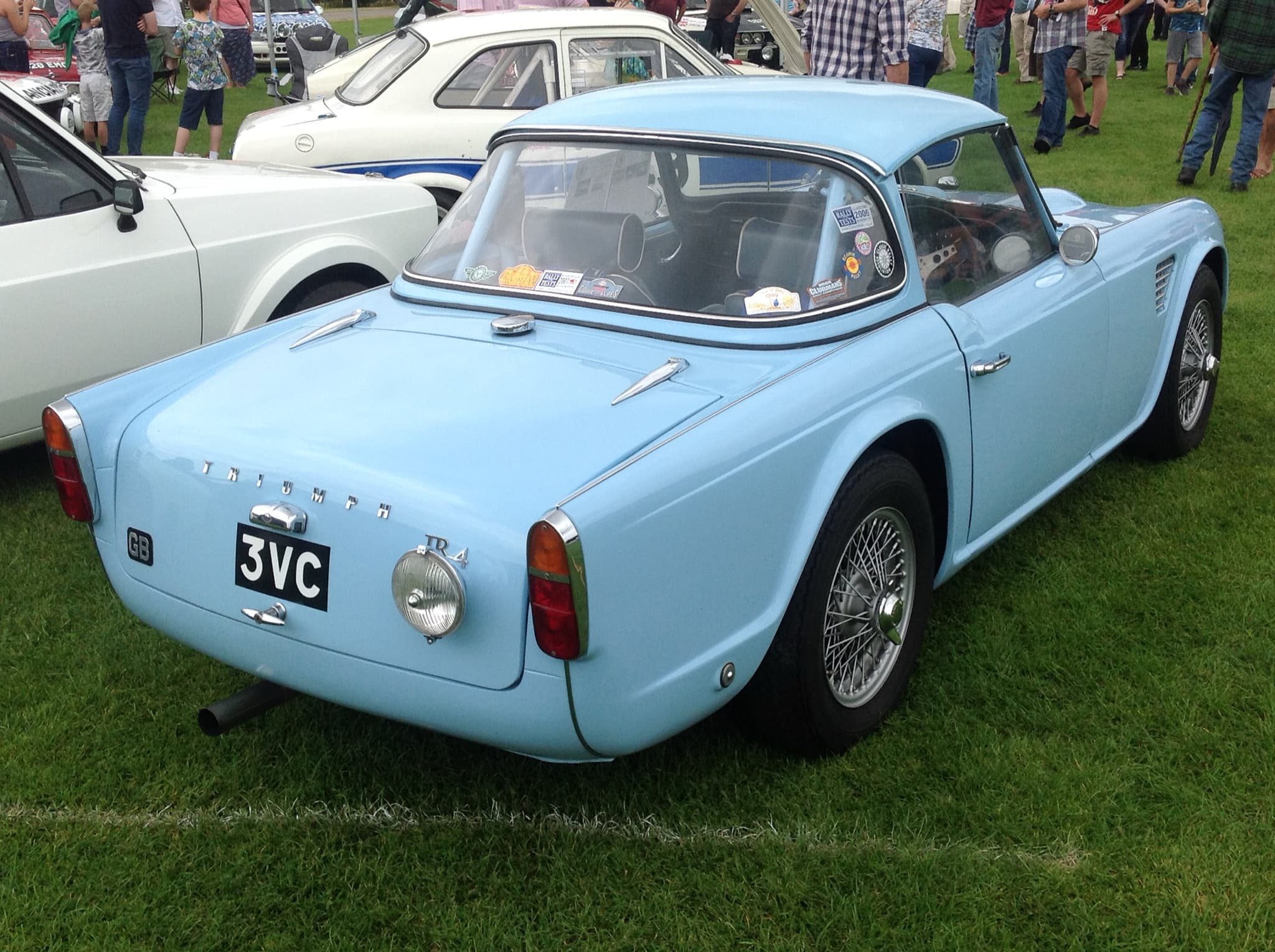
22 Classics at the Castle, Sherborne, Dorset, July 2016: a roll cage, rally stickers and a lamp on the boot lid of a pale blue TR4 hardtop wearing 3 VC, a works registration of 1962; whether this is the team's car, the frame cannot say.
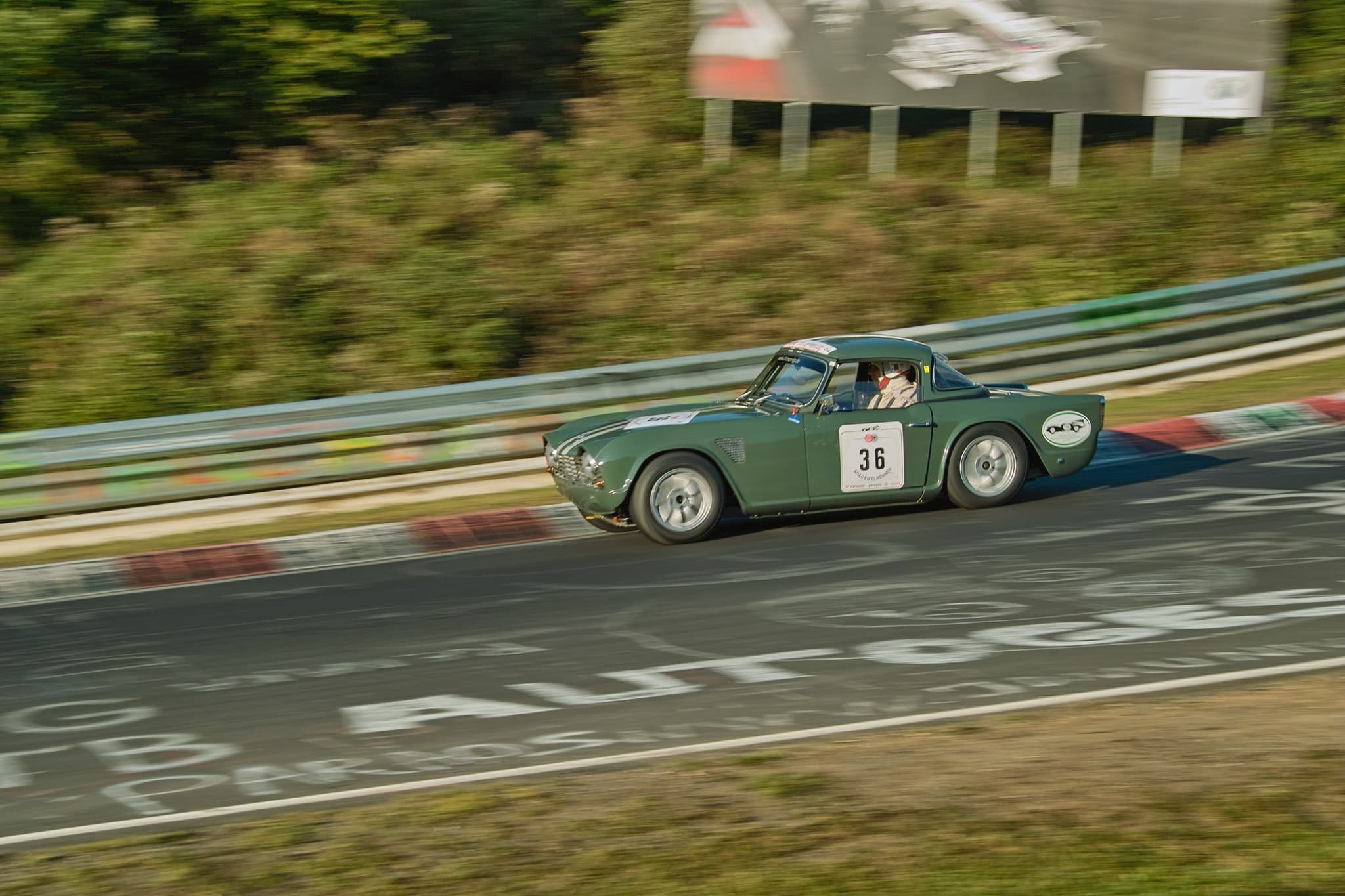
23 Nürburgring Nordschleife, 2008: a dark green TR4 hardtop, race number 36, sharp against trees streaked by the panning camera, in the ADAC Eifelrennen.
Picture credits (3)
- 21 Unknown photographer (Anefo), CC0
- 22 Andrew Bone, CC BY 2.0
- 23 Reinald Kirchner, CC BY-SA 2.0
Sources
Every source the site cites is on the sources page.
- Primarymade at the time, by the maker or by people who were there
- Referenceserious later work: clubs, specialists, magazines, books
- Aaron Severson, "Grandfather's Ax: The Many Evolutions of the Triumph TR4, Part 1: TR4 and TR4A", Ate Up With Motor, 22 Oct 2012, one body, 1961–67; the Dové sidebar: the glass-fibre roof and tail; the TR4A cars. ateupwithmotor.com/model-histories/triumph-tr4-tr4a/view-all Reference
- TR Drivers Club, "Early Cars: The TR4A", the TR4A's grille, lamps, strip and badges; the TR4A's wing lamps, chrome strip and IRS badge; the TR4A's walnut dashboard. trdrivers.com/earlycars/tr4A.html Reference
- TR Drivers Club, "Early Cars: The TR4", the TR4's grille lamps and plain flanks; the Surrey top: the vinyl insert and its frame. trdrivers.com/earlycars/tr4.html Reference
- Revington TR, "TR4: Technical Specification Change Points", CT6429, the longer bonnet bulge. revingtontr.com/the-tr-series/tr4/technical-specification-change-points Reference
- Graham Robson (essay "15 Years of Evolution"), Triumph TR2 – TR3/3A, TR4/4A – TR5, TR250 1953–1968 Parts & Accessories Catalogue, Rimmer Bros, edn 2.1 (source code TR2512), Part 1, p. 7: CT6429 among the numbers of 1962. rimmerbros.com/images/PDFs/TR2-5_Part1.pdf Reference
- Vintage Triumph Register, "TR4A" (history, change points and yearly output, buyer's and spotter's guides, numbering), the live-axle cars for North America; SUs again from CTC62191; Strombergs on some later cars. vintagetriumphregister.org/tr4a Reference
- Autocar, "Dové GTR4 2,138 c.c." (Road Test No. 1926), 7 Jun 1963, pp. 993–997, L. F. Dove and Thomas Harrington Ltd, Hove; the change from SU to Stromberg, 1963. Primary
- Dennis May, "Technical Report" on the TR-4 (cover story), Car and Driver, Oct 1961, pp. 19–23, p. 20: the two-piece hardtop; "surrey top" in factory parlance; pp. 19–21: the wet-liner four. Primary
- Bill Boddy ("W. B."), "The new Triumph TR4", Motor Sport, Sep 1961, p. 17, the Vynide "Surrey". motorsportmagazine.com/archive/article/september-1961/17/the-new-triumph-tr4 Primary
- Arthur Kelly (the VTR's TR4 consultant), "TR4": "A Historical Overview of the TR4" and the TR4 commission-number page, Vintage Triumph Register, the painted dash; walnut later, and fitted to earlier cars since; the TR4's colours; codes on the plate from 1963. vintagetriumphregister.org/tr4 Reference
- Goodwood Classic Solutions, "Buyer's guide: Triumph TR4", 1 Nov 2024, painted dashboards. insurance.goodwood.com/buyers-guide/triumph-tr4-2 Reference
- TR Drivers Club, "Triumph TR4", the Stromberg change. trdrivers.com/articles21/triumphtr4.html Reference
- Revington TR, "TR4A: Technical Specification Change Points", the carburettor changes. revingtontr.com/the-tr-series/tr4a/technical-specification-change-points Reference
- Triumph Sports Owners Association, Triumph Sports Owners Association Newsletter, September 1961 (TR-4 special issue), Sep 1961 (vol. VII no. 9), the six launch colours. vintagetriumphregister.org/tsoa/TSOASep61.pdf Primary
- Nationaal Archief (Anefo), via Wikimedia Commons, "16 Tulpenrallye, L. Bertorelli-R. Doyle (GB) in eem Triumph TR 4." (press photograph), Bestanddeelnr 916-3431, 1964, Anefo, 916-3431: a British private crew. commons.wikimedia.org/wiki/File:16_Tulpenrallye,_L._Bertorelli-R._Doyle_(GB)_in_eem_Triumph_TR_4.,_Bestanddeelnr_916-3431.jpg Primary
- Julian Balme, "TR4: Triumph's rally underdog", Classic & Sports Car, 4 Aug 2021, the works team, 1962–64; 3 VC to 6 VC. classicandsportscar.com/features/tr4-triumphs-rally-underdog Reference